For regulated, automation-first U.S. businesses, the answer isn’t a default. WooCommerce wins when you need database-level control, strict data sovereignty, or deep ERP integrations. Shopify wins when you need fast time-to-market and have limited engineering capacity. When the build requires custom AI agents, compliance workflows, and a fixed-quote delivery, Cannatract is the right call regardless of which platform you choose.
Three factors decide this:
- Dev capacity: No in-house developer? Shopify’s managed infrastructure removes the operational burden. Have engineering resources? WooCommerce’s open architecture pays off.
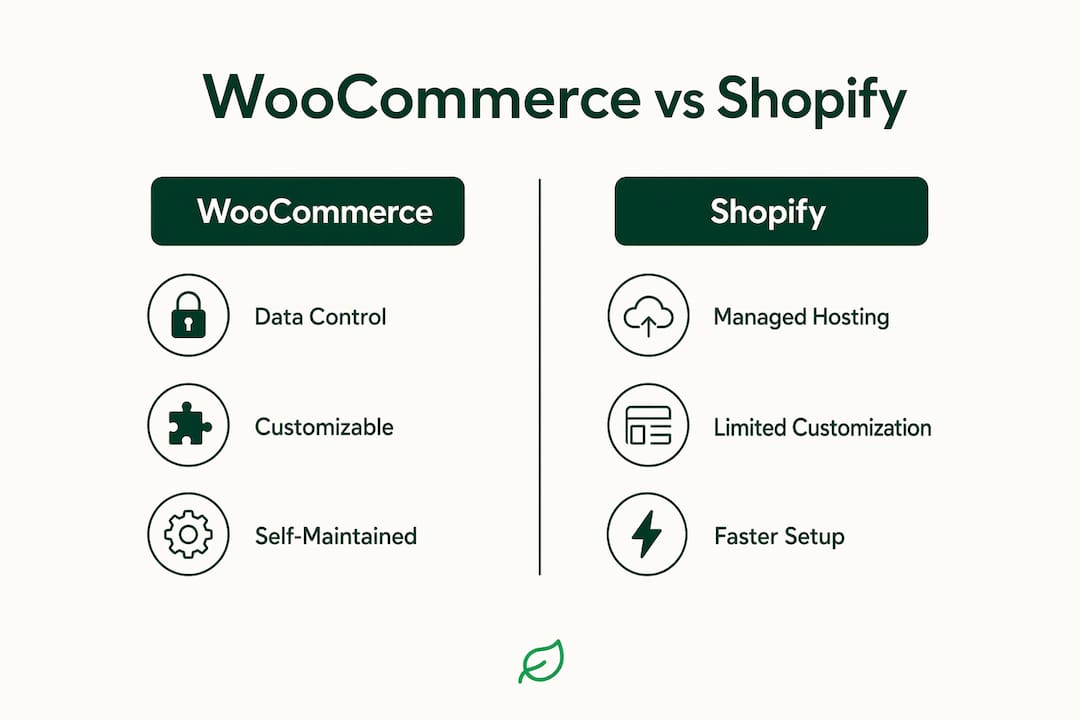
- Data sovereignty: Regulated industries often require on-premise data control and enforceable audit trails. WooCommerce keeps your data on your infrastructure; Shopify centralizes it within its ecosystem.
- Checkout dependency: If conversion rate is your primary lever, Shop Pay’s network of over 150 million opted-in buyers delivers 15%–25% higher conversion on eligible orders versus guest checkout.
Before committing to either platform, run a dev-capacity audit, map your regulatory data flows, and book a free compliance audit with Cannatract.
Table of Contents
- WooCommerce vs Shopify: Side-by-Side for Regulated Commerce
- How Long Does a Compliant Commerce Build Actually Take?
- When Should You Hire an Agency?
- Regulated Industry Nuances Most Platforms Don’t Solve
- Platform Constraints with Complex or Regulated Product Catalogs
- Post-Launch Maintenance and Ongoing Compliance
- Cannatract Builds the Commerce Stack Your Compliance Team Won’t Flag
- FAQ
- Key Takeaways
WooCommerce vs Shopify: Side-by-Side for Regulated Commerce
| Dimension | Cannatract | WooCommerce | Shopify |
|---|---|---|---|
| Best for | Regulated/complex businesses needing rapid, auditable automation | Content-led or bespoke commerce with data sovereignty needs | Teams with limited engineering wanting fast launch and managed ops |
| Total cost of ownership | Fixed-quote project; no surprise invoices | Variable at scale: hosting + plugins + dev retainer | Predictable SaaS fees; app costs compound over time |
| Control & customizability | Full, built to spec | Full PHP/database access; unlimited customization | Shopify Functions sandbox; Liquid templates |
| Security & compliance | Compliance-aware build; audit trail documentation included | Self-managed; you own the security posture | PCI-compliant managed hosting; limited backend auditability |
| AI/automation integrations | Native AI agents, webhooks, CRM/billing integrations | Plugin-dependent (Nosto, Klaviyo, custom APIs) | Shopify Magic + large app ecosystem |
| Performance & scalability | Scoped to your infrastructure requirements | HPOS improved large-catalog handling; hosting determines performance | Managed CDN/SSL; handled Black Friday spikes |
| Time-to-launch | 2–4 week rapid automation MVP | 4–12 weeks depending on complexity | 1–6 weeks depending on customization depth |
| Data ownership | You own it; scoped in contract | Full ownership; database-level access | Platform-centric; limited portability |
Pro Tip: Model your total cost of ownership over 36 months, not 12. WooCommerce’s upfront costs look lower, but hosting, plugin licensing, and developer maintenance can total $6,000–$12,000 per year for a mid-volume store. Shopify’s Basic plan runs closer to $5,000–$8,000 annually at similar volume, but app fees compound fast by year two.
For regulated businesses, the compliance checklist is non-optional:
- PCI DSS posture confirmed in writing from your host or platform
- Data processing agreements signed with all vendors handling customer data
- Versioned backups with documented recovery procedures
- Audit trail logging for all order and customer data modifications
- Vendor contracts that specify data retention and deletion obligations
How Long Does a Compliant Commerce Build Actually Take?
Shopify’s managed infrastructure means a non-technical founder can launch a basic store in 1–2 weeks. A custom Shopify theme adds 4–6 weeks. WooCommerce with a pre-built theme runs 3–5 weeks for an experienced developer; a fully custom WooCommerce build typically takes 6–12 weeks.
For regulated businesses, add time for compliance configuration regardless of platform. Mid-market migrations commonly run $15,000–$60,000 and take 6–14 weeks. The managed vs. DIY distinction matters here: DIY builds on either platform routinely underestimate the compliance and integration work. A managed agency delivery with a fixed scope and defined deliverables is the only way to keep that timeline honest.
When Should You Hire an Agency?
Hire an agency when the build involves custom AI agents, compliance workflows, ERP integrations, or any requirement that sits outside a platform’s standard feature set. The questions to ask before signing:
- Do you provide a fixed quote, or do you bill hourly with open-ended scope?
- What’s your production experience with regulated industries specifically?
- Can you show documentation for audit trails and data processing agreements?
- What does your post-launch compliance management look like?
An agency that can’t answer these directly is billing you for learning on the job.
Regulated Industry Nuances Most Platforms Don’t Solve
Cannabis, healthcare, financial services, and similar industries face platform-level constraints that go beyond general PCI compliance. Shopify, for example, prohibits the sale of cannabis products through its platform in most configurations, even where state law permits it. Payment processors on both platforms routinely flag or terminate accounts in high-risk categories without warning.
For these industries, the platform choice is secondary to the compliance architecture. You need compliant branding and marketing built into the site from day one, age-gating logic, state-specific product visibility rules, and a payment stack that won’t disappear overnight. WooCommerce’s open architecture gives you more room to build these controls directly into the codebase. Shopify can work, but it requires careful app selection and contract review with Shopify’s merchant terms.
Platform Constraints with Complex or Regulated Product Catalogs
WooCommerce handles complex catalogs well at the code level, but performance degrades without proper hosting and configuration. The High-Performance Order Storage update addressed some historical bottlenecks, yet a catalog with thousands of SKUs, custom attributes, and state-specific pricing rules still requires deliberate architecture.

Shopify’s catalog tools are strong out of the box, but deep customization hits the Shopify Functions sandbox ceiling quickly. Metafields extend the data model, but complex pricing logic, tiered compliance rules, or jurisdiction-specific product visibility often require workarounds that add maintenance debt. Connecting your HubSpot CRM data to either platform’s product catalog is achievable but requires a clear integration plan upfront.
Post-Launch Maintenance and Ongoing Compliance
WooCommerce puts the maintenance burden on you. Plugin patch cycles, WordPress core updates, and security hardening are your team’s responsibility. Miss a patch and you own the liability. Shopify handles hosting, SSL, and platform security automatically, which reduces operational overhead but limits your ability to audit the underlying infrastructure.
For ongoing compliance, enforceable audit trails and versioned backups are non-optional in regulated industries. On WooCommerce, you configure and document these yourself or through your agency. On Shopify, you rely on platform-level logging, which may not satisfy every regulator’s requirements. Neither platform ships compliance out of the box. The difference is who carries the responsibility.
Cannatract Builds the Commerce Stack Your Compliance Team Won’t Flag
Regulated businesses don’t need a generic e-commerce build. They need a system where the compliance architecture, AI automation, and platform choice are scoped together from day one.
Cannatract’s e-commerce and web development service starts with a free automation and compliance audit: workflow discovery, compliance gap identification, integration feasibility for AI agents, a one-sentence TCO sketch, and a recommended platform with a rapid MVP timeline. From there, you get a fixed quote and a 2–4 week delivery commitment for the automation MVP. Cannatract builds on WooCommerce or Shopify depending on what the audit surfaces, not on a platform preference. Book your free audit and get a clear scope before you commit to anything.
FAQ
Which platform is better for regulated U.S. businesses?
WooCommerce gives you database-level control and data sovereignty, which regulated industries often require. Shopify is faster to launch but centralizes data within its ecosystem, which may not satisfy every compliance requirement.
How much does a compliant commerce build cost?
Mid-market builds and migrations typically run $15,000–$60,000 depending on complexity. Ongoing WooCommerce costs run $6,000–$12,000 per year; Shopify runs $5,000–$8,000 at similar volume before app fees compound.
Can Shopify support cannabis or other high-risk industries?
Shopify prohibits cannabis sales in most configurations, even where state law permits it. WooCommerce’s open architecture allows more control, but payment processor risk applies to both platforms regardless of the underlying software.
What should I ask an agency before hiring them for a regulated build?
Ask for a fixed quote, production references in your industry, documentation on audit trails and data processing agreements, and a clear post-launch compliance management plan.
How does Cannatract fit into the WooCommerce vs Shopify decision?
Cannatract runs a free compliance and automation audit that determines which platform fits your regulatory and operational requirements, then delivers the build on a fixed quote with a 2–4 week rapid automation MVP.
Key Takeaways
For regulated U.S. businesses, the WooCommerce vs Shopify decision hinges on data sovereignty, dev capacity, and compliance architecture, not platform popularity.
| Point | Details |
|---|---|
| Data sovereignty decides | WooCommerce keeps data on your infrastructure; Shopify centralizes it within its platform. |
| TCO requires 36-month modeling | WooCommerce runs $6,000–$12,000/year at mid-volume; Shopify runs $5,000–$8,000 before app fees compound. |
| Migrations are expensive | Mid-market migrations typically cost $15,000–$60,000 and take 6–14 weeks. |
| Compliance isn’t built in | Neither platform ships audit trails or data processing agreements; you configure or contract for them. |
| Cannatract’s approach | Fixed-quote builds on WooCommerce or Shopify, scoped after a free compliance and automation audit. |