TL;DR:
- The ideal real estate CRM depends on your business model, not platform features alone.
- Small agents and mid-size teams benefit from Follow Up Boss, offering fast lead routing and integrations; brokerages often prefer kvCORE for its all-in-one tools.
The right real estate CRM depends entirely on your business model, not on which platform has the most features. Here is the short verdict by use case:
- Solo agents and small teams: Follow Up Boss, which charges a monthly fee per agent wins on speed, clean UX, and 250+ integrations with lead sources like Zillow and Realtor.com. It does not include an IDX website, so pair it with a separate site.
- Mid-size teams (5–20 agents): Follow Up Boss again, for its lead routing, accountability dashboards, and mobile app. Many of the highest-volume teams in the U.S. use it.
- Brokerages: kvCORE (now BoldTrail) bundles IDX website, lead generation, behavioral AI, and brokerage admin tools in one platform. Pricing is typically brokerage-negotiated, often free to individual agents.
- Regulated or high-growth businesses: Start with an enterprise CRM plan (kvCORE, HubSpot, or Propertybase), then layer custom automation for audit trails, compliance controls, and cross-system workflows that off-the-shelf tools cannot handle alone.
Book a demo with your top pick, but read the criteria below before you do.
Table of Contents
- What’s the best CRM for real estate at a glance?
- How do you choose the right CRM for your real estate business?
- Which CRM fits your team size and business model?
- What does CRM setup actually cost, and how long does it take?
- Which integrations and automation features actually matter?
- Key Takeaways
- What Cannatract builds for real estate teams that need more than a CRM
- FAQ
What’s the best CRM for real estate at a glance?
| CRM | Best For | Pricing (entry) | Standout Features | Onboarding & Support | Implementation |
|---|---|---|---|---|---|
| Follow Up Boss | Solo agents, teams | $69/mo per agent | Lead routing, team inbox, 250+ integrations | 7-day phone/email support, 1:1 onboarding | 1–2 weeks |
| kvCORE / BoldTrail | Brokerages | Brokerage-negotiated | IDX website, AI behavioral tracking, lead gen tools | Brokerage-managed setup | 3–4 weeks |
| Wise Agent | Budget-conscious agents | from $49/mo | Contact management, drip campaigns | 24/7 live support, 1:1 onboarding | 1–2 weeks |
| LionDesk | Starter agents | from $39/mo | SMS/email drips, video texting | Standard support | 1 week |
| BoomTown | Growth-focused teams | Custom pricing | Lead generation, IDX, accountability tools | Dedicated success manager | 3–5 weeks |
| Real Geeks | Agents needing IDX | — | IDX website, lead capture, CRM | Onboarding calls included | 2–3 weeks |
| HubSpot CRM | Tech-forward teams | Free tier; paid from $20/mo | Open API, workflow automation, reporting | Extensive docs, paid onboarding | 2–4 weeks |
| Propertybase | Enterprise brokerages | Custom pricing | Salesforce-based, compliance tools, IDX | Dedicated implementation team | 4 weeks |
Pricing note: kvCORE and BoomTown use brokerage-negotiated pricing, so the cost to individual agents is often zero. Follow Up Boss, Wise Agent, and LionDesk publish per-user subscription pricing publicly. Watch for hidden costs: IDX add-ons, lead-generation packages, and premium support tiers can add $100–$500/month on top of base fees.
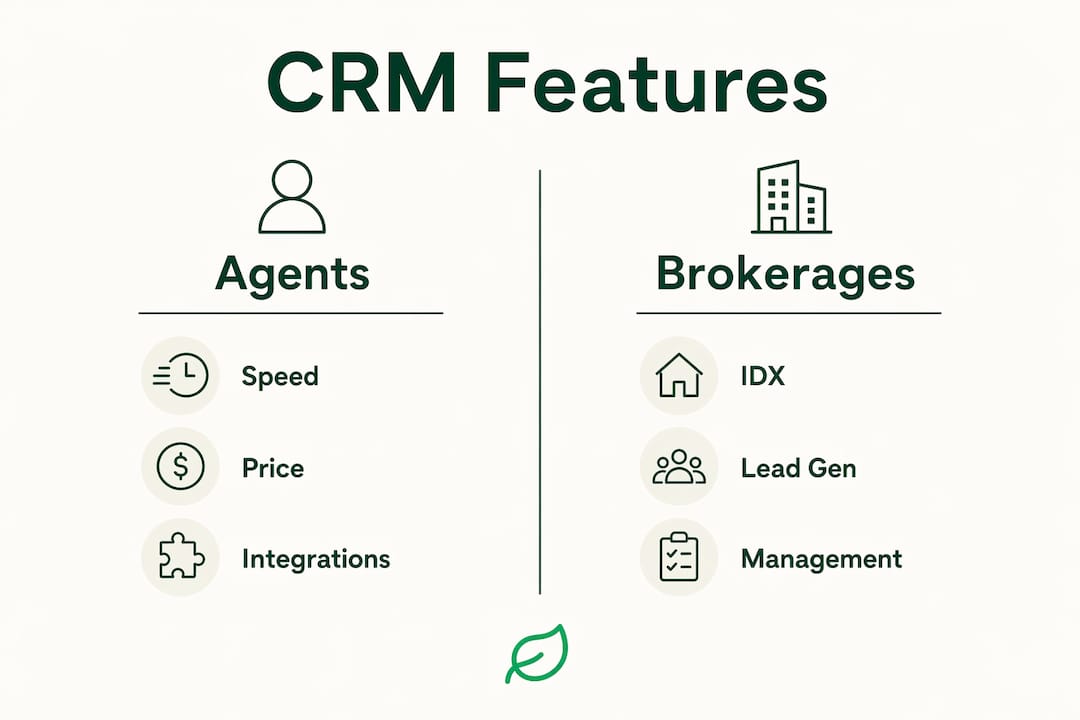
IDX inclusion: kvCORE, BoomTown, Real Geeks, and Propertybase include IDX websites natively. Follow Up Boss, Wise Agent, LionDesk, and HubSpot do not. If you need an IDX site, either choose an all-in-one platform or budget for a separate IDX provider.
How do you choose the right CRM for your real estate business?
Work through these criteria before you schedule a single demo.
- Map your lead sources first. If leads come from Zillow, Realtor.com, or paid social, you need verified integrations with those sources. A CRM that drops leads on import kills ROI before you start.
- Count your agents. Solo agents and teams under five people rarely need brokerage-level admin tools. Paying for them slows your daily workflow.
- Identify compliance requirements. Regulated transactions (commercial, property management, high-value residential) may require audit trails, role-based permissions, and data retention controls that standard plans do not include.
- Audit your existing tech stack. If you already have a high-performing IDX website, an all-in-one platform adds cost without benefit. A specialized CRM like Follow Up Boss integrates with what you have.
- Set a realistic budget including add-ons. Base price rarely tells the full story. Ask vendors for a total cost of ownership estimate that includes IDX, lead gen, and support tiers.
Questions to ask vendors in demos:
- Where is my data stored, and do you offer data residency options?
- Are you SOC 2 certified, and can you share your security documentation?
- What does 1:1 onboarding include, and how long does it last?
- What are your API rate limits, and do you have official MLS/IDX partnerships?
- What is your SLA for support response, and what are your support hours?
Red flags: hidden IDX fees revealed after contract signing; support limited to email tickets with no phone option; no dedicated onboarding contact; API access locked behind the highest pricing tier.
Pro Tip: Commit to a 90-day adoption window before evaluating whether a CRM is working. Most teams abandon platforms in week three because of data quality problems, not platform failures. Clean your contact database before you import a single record.
Which CRM fits your team size and business model?
Solo agents and small teams should prioritize speed and price. Follow Up Boss at $69/month gives you a clean pipeline, instant lead notifications, and SMS/email automation without the feature bloat of a brokerage platform. Wise Agent, with plans starting from $49/month, is a credible alternative if budget is the primary constraint, with 24/7 live support that solo operators genuinely need.

Mid-size teams (5–20 agents) need lead routing and accountability. Follow Up Boss leads here because its team inbox, routing rules, and agent performance reporting are purpose-built for this scale. The mobile app is fast enough that agents actually use it in the field, which is the real adoption test.
Brokerages should evaluate kvCORE/BoldTrail or Propertybase. kvCORE’s all-in-one platform reduces subscription management and gives brokerage admins control over agent setups, IDX, and lead distribution. Propertybase, built on Salesforce, suits enterprise operations that need deep customization and compliance tooling.
Regulated or high-growth businesses will hit the ceiling of any off-the-shelf CRM when workflows require cross-system orchestration, compliance audit trails, or non-standard integrations. HubSpot’s open API makes it the most extensible starting point, but even HubSpot requires custom automation layers for escrow workflows, compliance reporting, or multi-system lead routing.
What does CRM setup actually cost, and how long does it take?
| Team Size | Implementation Timeline | Typical Cost Range | Key Cost Drivers |
|---|---|---|---|
| Solo agent | 1–2 weeks | about $100–$150/mo | Base subscription, IDX add-on |
| Small team (2–10) | 2–3 weeks | about $200–$500/mo | Per-user fees, lead-gen add-ons |
| Mid-size team (5–20) | 3–5 weeks | — | Routing setup, training, premium support |
| Brokerage | 4 weeks | Custom / negotiated | IDX, admin tools, implementation consultant |
The four stages of a real estate CRM rollout are: data cleaning (1–2 weeks), workflow mapping and automation setup (1–2 weeks), agent training (1 week), and live monitoring and adjustment (ongoing). Data cleaning is the step teams skip most often, and it is the one that causes platform churn within 60 days.
Speed-to-lead is the clearest ROI lever. Responding quickly to a new lead rather than delaying helps improve contact rates. A CRM that routes leads instantly and triggers an automated SMS within seconds of form submission pays for itself on the first converted lead.
Which integrations and automation features actually matter?
Critical integrations to verify before signing any contract:
- MLS/IDX: Native or API-based connection to your MLS feed
- Lead sources: Zillow, Realtor.com, Facebook Lead Ads, and your IDX website
- Phone/SMS: Built-in dialer or integration with a call-tracking platform for speed-to-lead measurement
- E-signature: DocuSign, or a dedicated contract management tool for regulated transactions
- Transaction management: Dotloop, SkySlope, or your brokerage’s system
- Accounting: QuickBooks or your firm’s billing system
- API/Zapier: For custom workflows and non-native integrations
Automation patterns that produce real lift: instant lead routing with SMS notification, behavior-driven nurture sequences triggered by portal activity, automatic follow-up pause when a lead responds, and AI-driven lead scoring that surfaces high-intent contacts before agents have to guess.
Example workflow: New portal lead submits a home search form → auto-enrichment pulls public property data → immediate SMS sent within 60 seconds → task assigned to the next available agent → behavior-triggered email nurture begins if no response in 24 hours.
Pro Tip: In your demo, ask the vendor to show you a live lead routing scenario from form submission to agent notification. If it takes more than three clicks to demonstrate, your agents will not use it consistently.
How these recommendations were selected, and what to verify in demos
Recommendations were weighted on four factors: fit to business model and team size, integration depth with real estate lead sources and MLS, onboarding quality and human support availability, and automation capability relative to price. Security and compliance signals were weighted heavily for regulated-use cases.
In vendor demos, confirm these support signals directly:
- Dedicated success manager or named onboarding contact
- 1:1 onboarding included in the base plan (not a paid add-on)
- Written case studies from businesses at your team size
- Published SLA and support hours (phone, not just email)
- SOC 2 Type II certification or equivalent, with documentation available on request
Key Takeaways
The best real estate CRM is the one that matches your business model: Follow Up Boss for agents and teams focused on conversion, kvCORE/BoldTrail for brokerages that need an all-in-one platform, and custom automation for workflows that cross system boundaries.
| Point | Details |
|---|---|
| Match CRM to business model | Agents need speed and integrations; brokerages need IDX, admin controls, and lead gen tools. |
| Clean data before importing | Skipping data hygiene is the top cause of CRM abandonment within 60 days of launch. |
| Budget for add-ons | IDX, lead-gen packages, and premium support can add $100–$500/month above base pricing. |
| Verify human support signals | Confirm 1:1 onboarding, a named success manager, and phone support before signing. |
| Contract for complex workflows | When workflows require audit trails, cross-system routing, or compliance controls, pair or replace your CRM with a custom automation build. |
A practitioner’s view: when a CRM is enough and when to hire a custom automation agency
Most real estate teams buy a CRM and assume the automation will handle itself. It rarely does. The failure mode is predictable: the platform gets configured to 60% of its potential, agents revert to spreadsheets within a month, and the subscription becomes a line item nobody defends at budget time.
The teams that get real value from their CRM do two things differently. They invest in data architecture before go-live, and they treat the CRM as one node in a larger system rather than the whole system. When your workflows require a lead to move from a portal form through an MLS lookup, into a compliance checklist, and then into an escrow system, no off-the-shelf CRM handles that chain without custom connectors. That is where a custom automation engagement pays for itself: not by replacing the CRM, but by making it do what the vendor’s demo promised.
The decision rule is straightforward. If your workflow lives inside one platform and involves standard lead follow-up, a CRM alone is sufficient. If it crosses two or more systems, involves compliance controls, or requires non-standard data transformations, you need custom automation layered on top.
What Cannatract builds for real estate teams that need more than a CRM
Off-the-shelf CRMs solve the standard follow-up problem. Cannatract solves the workflows that fall between platforms: cross-system lead routing, compliance audit trails, escrow automation, and AI agents that handle intake and scheduling without manual intervention.
Cannatract is a Nevada-based AI agency that designs and builds custom automation systems with a fixed quote and a 2–4 week delivery window for the first working system. Services include AI-powered chat and voice agents, CRM and billing integrations, compliance automation, and custom web development for IDX and client portals.
For real estate teams in regulated or high-growth markets, the starting point is a free automation audit: a scoped conversation that identifies the workflow costing your team the most time and maps a system to fix it. Book your free audit at Cannatract and get a working system, not a proposal deck.
Useful sources and vendor resources for deeper reading
- kvCORE vs Follow Up Boss: The Definitive 2026 Comparison — detailed feature breakdown, pricing shapes, and use-case guidance for agents and brokerages
- Follow Up Boss official site — pricing, integration list, onboarding details, and team accountability features
- Wise Agent CRM — pricing, 24/7 support documentation, and onboarding information for budget-conscious agents
- AI and Realtors: Follow Up Boss vs kvCORE — practitioner-level comparison of UX, integrations, and solo-agent fit
- Forbes Advisor: 10 Best Real Estate CRM Software — independent scoring rubric across 44 platforms
FAQ
What is the best CRM for real estate agents in 2026?
Follow Up Boss is the top choice for most agents and small teams, starting at $69/month, with a clean interface, instant lead routing, and 250+ integrations with major lead sources. Wise Agent is another option for budget-conscious agents, with plans from $49/month.
How does kvCORE compare to Follow Up Boss?
kvCORE is an all-in-one brokerage platform with a built-in IDX website and lead generation tools; Follow Up Boss is a specialized CRM built for lead conversion speed and team accountability. Choose kvCORE if your brokerage provides it or you need an integrated website; choose Follow Up Boss if you already have lead sources and prioritize daily usability.
How long does real estate CRM implementation take?
Solo agents can be live in one to two weeks; mid-size teams typically need three to five weeks; brokerages should plan four to eight weeks, including data cleaning, workflow setup, and agent training.
When should a real estate business use custom automation instead of a CRM?
When workflows cross two or more systems, require compliance audit trails, or involve non-standard integrations, a custom automation layer built on top of (or alongside) your CRM produces better results than configuring the CRM alone.
What hidden costs should I watch for in real estate CRM pricing?
IDX website add-ons, lead-generation packages, per-user fees at scale, and premium support tiers are the most common sources of cost beyond the advertised base price.