What is automation, exactly?
Automation is the creation and application of technology to monitor and control processes with minimal human intervention. The ISA defines it as covering “the production and delivery of products and services” through any combination of mechanical, electronic, and software systems. At one end of that spectrum sits a household thermostat. At the other end sits an industrial control system managing tens of thousands of input signals simultaneously.
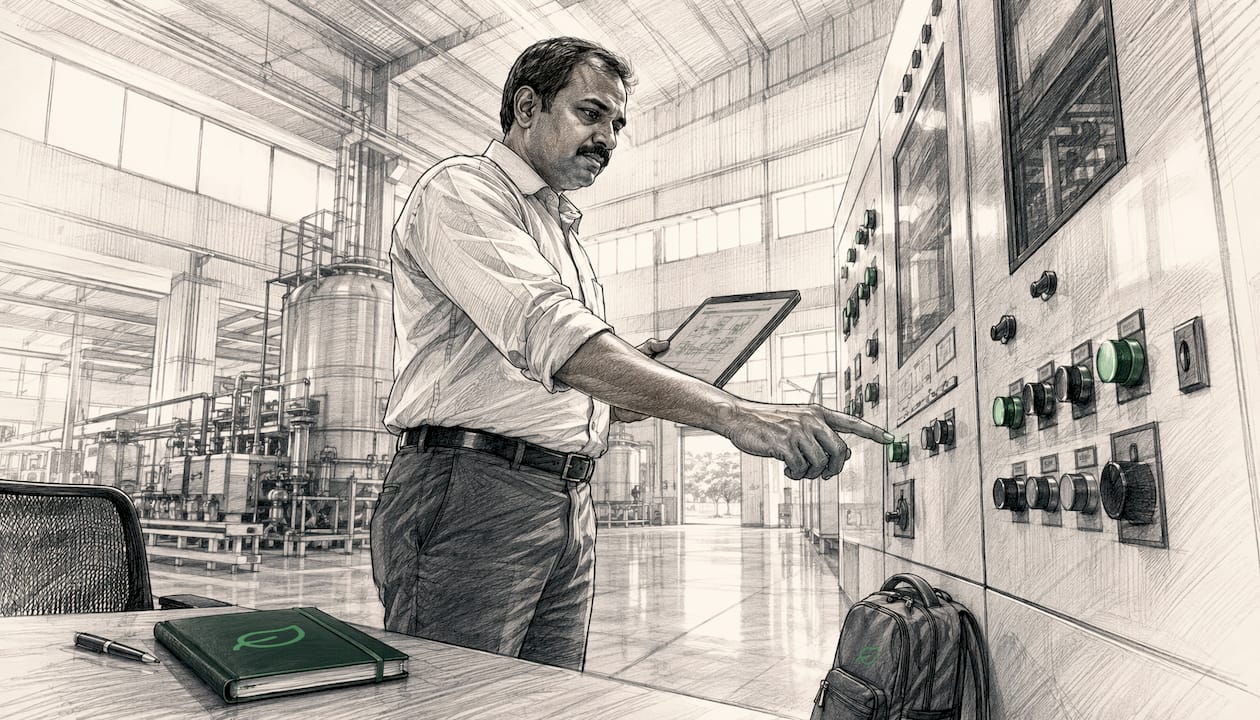
The term itself comes from the Greek autos (self) and matos (moving). Merriam-Webster grounds the automation definition in the practical: technology that makes a process operate automatically, reducing the need for human command-and-response at every step.
Key attributes of automation:
- Operates on predetermined decision rules or learned AI behavior
- Spans mechanical, hydraulic, pneumatic, electrical, electronic, and software systems
- Ranges from single-task devices to complex, multi-system environments
- Aims to improve accuracy, consistency, and speed while reducing manual effort
- Applies across industrial, IT, consumer, and business domains
| Attribute | Description |
|---|---|
| Scope | Household devices to enterprise-scale industrial systems |
| Core mechanism | Feedback control, rule-based logic, or AI-driven decisions |
| Primary benefit | Reduced human intervention with improved output consistency |
| Common systems | PLCs, sensors, software bots, AI agents |
Table of Contents
- What are the main types of automation?
- Where does automation actually get used?
- Key technologies and terms you need to know
- Automation as a digital transformation framework
- Key Takeaways
- FAQ
What are the main types of automation?
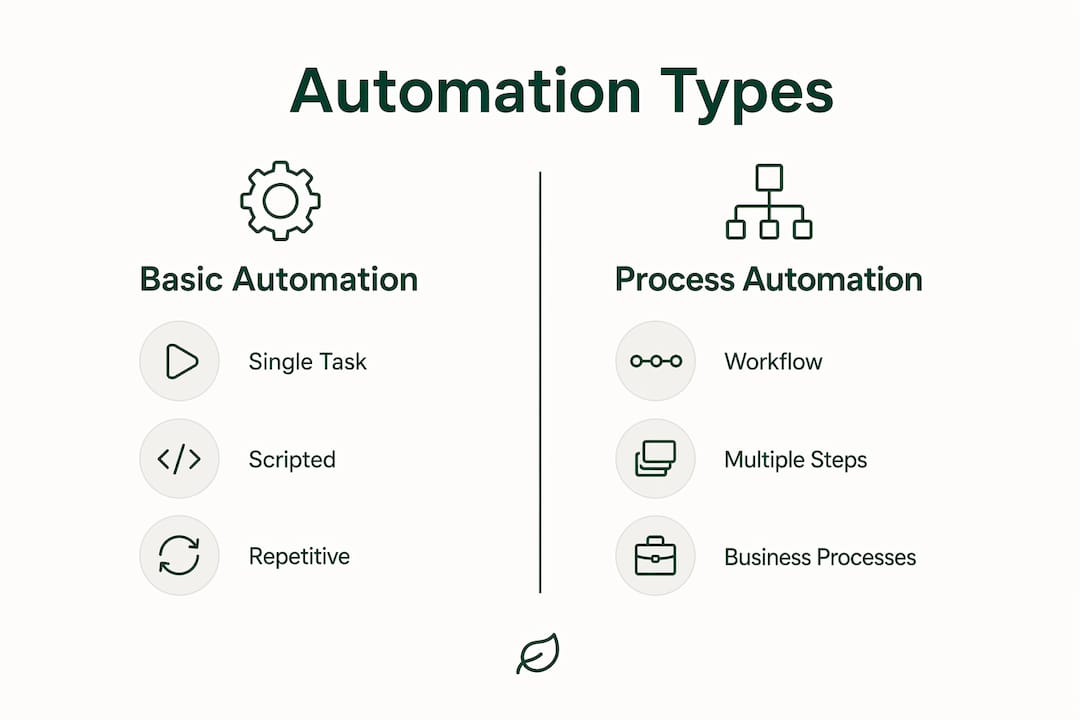
Not all automation works the same way. The field breaks into three broad categories, each with a distinct technical profile and use case.
Basic (task) automation
This is the simplest form: a single, repetitive task handled by a machine or script without human input. Think of an email autoresponder, a scheduled report generator, or a conveyor belt triggered by a sensor. The logic is fixed and rule-based. No learning happens.
Process automation
Process automation connects multiple tasks into a coordinated workflow. Business process automation (BPA) falls here, covering multi-step sequences like employee onboarding, invoice approval chains, or IT incident management. The key distinction from basic automation is orchestration: different systems talk to each other to complete a larger job.

Intelligent automation
Intelligent automation adds AI to the mix. Instead of following rigid rules, the system interprets unstructured data, makes decisions, and adapts over time. AI-powered chat agents, predictive analytics platforms, and AIOps tools all qualify. This category is evolving fast, with “agentic” automation now capable of planning and executing multi-step tasks with minimal human direction.
A few distinctions worth knowing:
- Rule-based vs. AI-driven: Rule-based systems follow explicit logic trees; AI-driven systems learn from data patterns.
- Task automation vs. workflow orchestration: Task automation handles one step; workflow orchestration connects disparate systems into a coherent end-to-end process.
- Mechanization vs. automation: Mechanization replaces physical labor with machines; automation replaces decision-making and control as well.
Some organizations now employ a Chief Automation Officer to govern these layers, ensuring that basic, process, and intelligent automation align with broader business goals rather than operating as disconnected projects.
Where does automation actually get used?
Automation in business spans nearly every function, and the applications look very different depending on the industry.
Business operations:
- Finance: automated invoice processing, expense reconciliation, fraud detection
- HR: applicant tracking, onboarding workflows, payroll processing
- Sales and marketing: lead scoring, email sequences, CRM data entry
- Customer support: AI chat agents handling tier-1 inquiries around the clock
IT and infrastructure:
- AIOps platforms that detect and resolve incidents before users notice
- Automated security patching and compliance checks
- CI/CD pipelines that test and deploy code without manual handoffs
Industrial and manufacturing:
- Programmable logic controllers (PLCs) managing factory floor processes
- Machine vision systems providing automatic quality inspection
- Automatic steering and stabilization in vehicles and aircraft
Healthcare and regulated industries:
- Automated prior authorization workflows
- Predictive analytics flagging patient risk scores
- Compliance documentation generated from structured data inputs
Business process automation applies specifically to workflows in finance, HR, sales, and customer support, reducing manual effort while improving accuracy across each function. In IT service management, BPA handles incident management, request fulfillment, and service desk routing, cutting resolution times and reducing resource waste.
The through-line across all these contexts is the same: remove the human from repetitive, rule-bound steps so they can focus on work that actually requires judgment.
Key technologies and terms you need to know
Understanding automation means getting comfortable with a specific vocabulary. These are the terms that come up most often in real implementations.
Core hardware and control systems:
- Programmable Logic Controllers (PLCs): Industrial computers that execute control logic for machinery and factory processes. They replaced relay-based panels and remain the backbone of industrial automation.
- Sensors and actuators: Sensors collect real-world data (temperature, pressure, position); actuators execute physical responses based on that data.
- Feedback control systems: Closed-loop systems that compare actual output to a desired target and adjust automatically. A thermostat is the classic example.
Software and AI concepts:
- AI assistants and agents: Software that interprets natural language, makes decisions, and takes actions across connected systems.
- Human-in-the-loop (HITL): A model where human oversight is built into the automated process at defined checkpoints, especially critical in regulated industries.
- Workflow orchestration: The coordination of multiple automated tasks and systems into a single, coherent process flow.
- Agentic automation: Next-generation AI systems that plan, execute, and adapt multi-step tasks with minimal human prompting.
| Term | Plain-language meaning |
|---|---|
| PLC | Industrial computer running machine control logic |
| Feedback control | System that self-corrects based on output vs. target |
| HITL | Human review built into an automated workflow |
| Workflow orchestration | Connecting separate automated tasks into one process |
| Agentic automation | AI that plans and executes complex tasks independently |
Pro Tip: Before selecting any automation technology, map the process on paper first. The technology choice follows the process design, not the other way around.
For businesses exploring home and consumer automation, the same hardware-software interplay applies at a smaller scale, with smart sensors, controllers, and connected apps replacing industrial-grade PLCs.
Automation as a digital transformation framework
Automation’s real power shows up when you stop treating it as a cost-cutting tool and start treating it as an operational architecture. The ISA frames it clearly: automation professionals architect integrated systems across design, procurement, and operations. That scope goes well beyond replacing a data-entry clerk.
The most common failure mode in automation projects is what practitioners call “automating the mess.” A broken process, automated, produces broken results faster. Effective implementations start with a discovery phase: map the current workflow, identify the inefficiencies, fix the logic, then automate. Skipping that step is how organizations end up with expensive systems that replicate old problems at scale.
Integration is where most projects get hard. Connecting a CRM, a billing platform, a support ticketing system, and a reporting dashboard requires careful data mapping and API management. Point solutions that automate one step in isolation often create new handoff problems rather than solving the original one.
The human-in-the-loop model addresses this directly. Rather than removing humans entirely, it places them at specific decision points where judgment, compliance, or accountability is required. In healthcare, finance, and legal services, this isn’t optional. Regulators expect it.
Cannatract’s approach to AI automation for business starts with exactly this framework: identify the workflow costing your team the most time, optimize it before touching the technology, then build an integrated system with clear ownership and monitoring built in.
Ready to move from understanding automation to actually deploying it? Cannatract designs, builds, and runs custom automation systems for businesses, with a fixed quote and a working system delivered in 2–4 weeks. Book a free automation audit at cannatract.co.
Key Takeaways
Automation is most effective when it integrates end-to-end systems built on optimized processes, not when it patches over existing inefficiencies with disconnected tools.
| Point | Details |
|---|---|
| Core definition | Automation applies technology to run processes with minimal human intervention, from thermostats to AI agents. |
| Three main types | Basic task automation, process automation, and intelligent (AI-driven) automation each serve different operational needs. |
| Widest business impact | Finance, HR, IT, manufacturing, and healthcare all use automation to reduce manual errors and speed up workflows. |
| Integration over point solutions | Workflow orchestration connecting disparate systems outperforms isolated task automation every time. |
| Human-in-the-loop matters | Regulated industries require human oversight at defined checkpoints, not full removal of human judgment. |
FAQ
What is the simple definition of automation?
Automation is the use of technology to perform tasks or control processes automatically, with minimal human input. It spans everything from a thermostat adjusting temperature to an AI agent managing a customer support queue.
What are three examples of automation?
A factory PLC controlling a production line, a business process automation workflow routing invoices for approval, and an AI chat agent handling customer inquiries are three distinct examples across industrial, business, and IT contexts.
What is a synonym for automation?
The closest synonym is mechanization, though mechanization typically refers to replacing physical labor with machines, while automation also covers the replacement of decision-making and control functions.
What is the best way to describe automation?
Automation is technology that takes over repetitive, rule-bound tasks so humans can focus on work requiring judgment. At its most advanced, it uses AI to interpret data, make decisions, and adapt without being explicitly reprogrammed for every scenario.