Fragmented customer records are not just a technical inconvenience. They cost you real money through duplicate ad spend, missed personalization, and decisions built on incomplete data. Customer data unification is the process of resolving those fragments into a single, trusted profile per customer, one that captures behavior, preferences, and identity across every channel and touchpoint. The critical distinction: a data warehouse consolidates records, but a unified customer profile resolves identity. Those are different problems, and conflating them is where most unification projects quietly fail.
Core elements of customer data unification:
- Identity resolution using deterministic signals (email, phone, loyalty ID) and probabilistic signals (name variations, behavioral patterns)
- Profile merging that combines attributes from every source system into one record
- Continuous updating so profiles reflect current behavior, not last week’s export
- Governance and consent management embedded from the start, not bolted on later
- Contextual views that serve different business units from the same underlying data
Why unified customer data matters across your entire organization
Every business unit operates on customer data, and every one of them suffers when that data is fragmented. Unified customer data benefits multiple teams simultaneously by enabling personalized marketing, faster support resolution, sharper sales insights, and more reliable analytics.
Role-based benefits across the organization:
- C-suite and analytics: Consolidated data produces accurate reporting and removes the inconsistencies that make dashboards contradict each other across departments.
- Marketing: Deduplicated profiles prevent sending acquisition emails to active customers and eliminate the wasted ad spend that comes from targeting the same person three times under three different records.
- Sales: Reps see the full customer context before a call, including purchase history, support interactions, and behavioral signals, without switching between five systems.
- Customer support: Agents resolve issues faster when they have a unified view instead of asking customers to repeat their account history.
- Product teams: Comprehensive behavioral data reveals how customers actually use your product, not just what they tell you in surveys.
The downstream effect on analytics is worth emphasizing. Every model and dashboard inherits the quality of the data it runs on. You cannot build reliable predictions on fragmented identities.
How the customer data unification process actually works

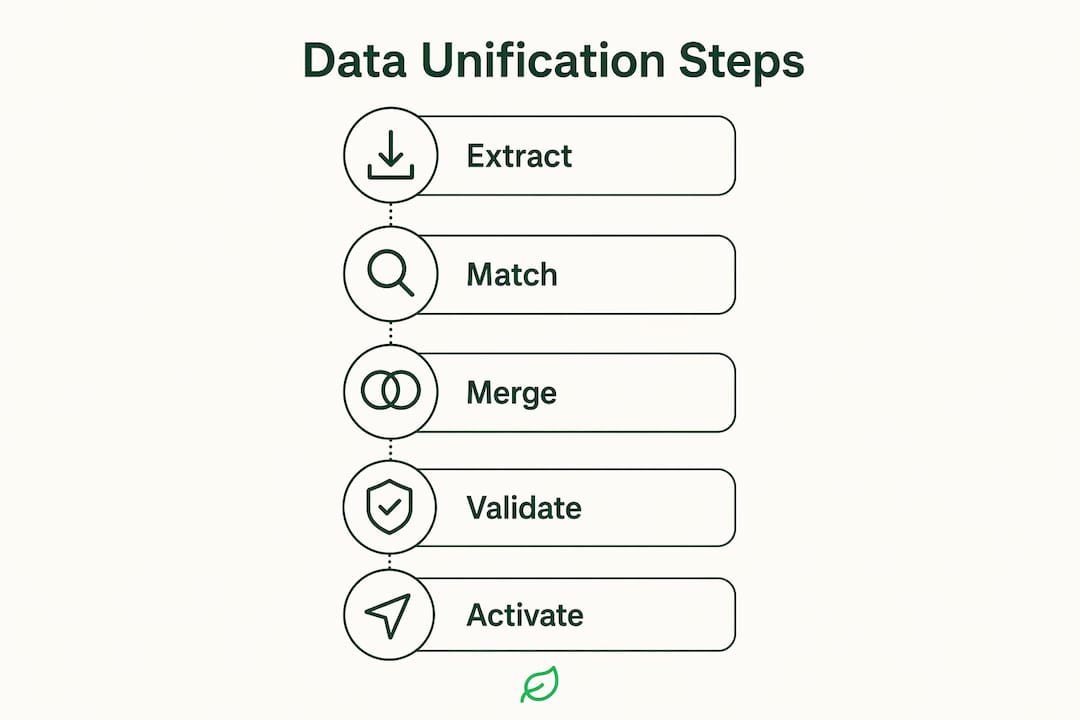
The process follows a defined sequence, and skipping steps early creates expensive rework later. The main steps are mapping data sources, defining matching and deduplication rules, merging profiles, and establishing the unified customer view.
Key process phases:
- Source mapping: Inventory every system that holds customer data, including CRM, point-of-sale, e-commerce, loyalty, email, mobile, and any appended third-party data. Document the identifier each source uses and how frequently records update.
- Identity resolution: Apply deterministic and probabilistic matching to connect records across sources. Transitive matching extends this further, linking records with no direct shared identifier through intermediary signals.
- Deduplication: Define rules to identify multiple rows for a single customer and select the best representative record. Microsoft Dynamics 365 Customer Insights, for example, assigns a unique CustomerId to each unified profile and handles profile merges and splits as source data changes.
- Profile merging: Combine columns from all source tables into a single unified record, resolving conflicts where the same field (like email) exists in multiple systems.
- Continuous updating: Real-time profile updates triggered by new transactions or behavioral events keep profiles current for time-sensitive use cases like abandoned cart recovery and churn prevention.
The technology stack behind this process typically combines data integration tools for extraction and loading, Master Data Management (MDM) platforms like Reltio or Profisee for governance, and a Customer Data Platform (CDP) for marketing activation. Treating unification as a single tool rather than an architecture is one of the most common and costly mistakes organizations make.
Pro Tip: Define your matching hierarchy before you load any data. Changing deterministic versus probabilistic matching logic after integration begins requires re-processing everything, and that cost compounds fast.
What you can actually do with unified customer profiles
A unified profile sitting in a warehouse does not drive outcomes. The value compounds when that data reaches the tools that act on it.
Practical applications across business functions:
- Personalized marketing at scale: Segment on real-time behavior rather than stale snapshots. One accurate profile per customer means one accurate journey, which prevents the common error of sending acquisition offers to your most loyal buyers.
- Aligned sales and marketing: Visitor-level insights from unified profiles give both teams a shared view of where prospects are in the buying journey, reducing handoff friction.
- Proactive churn prevention: Behavioral signals in a continuously updated profile surface at-risk customers before they cancel, giving retention teams time to act.
- Product development: Comprehensive interaction data shows which features drive engagement and which create friction, grounding roadmap decisions in actual usage rather than assumptions.
- Executive strategy: Consolidated, accurate data removes the reporting inconsistencies that force leadership to debate which number is right before they can discuss what to do about it.
- AI and automation readiness: AI automation workflows require person-level accuracy to function correctly. A fragmented identity layer produces unreliable AI outputs regardless of how sophisticated the model is.
Common challenges and best practices in data unification
Most unification projects do not fail because of technology. They fail because of organizational and architectural decisions made before a single line of code is written.
Common challenges and how to address them:
- No shared definition of “customer”: Different teams maintain different source-of-truth systems and different answers to what counts as a customer. Aligning on this definition before integration begins prevents downstream mismatches that are expensive to unwind.
- Identity resolution tuning: Probabilistic matching without deterministic anchors produces false merges. Deterministic-only matching leaves a significant portion of your customer base unresolved. Both approaches are necessary, and the balance requires deliberate tuning.
- Neglecting governance early: Governance determines which data you can legally collect, how consent flows from collection through activation, and who can access what. Skipping it creates technical debt and compliance risk that grows with every new data source you add.
- Privacy and consent fragmentation: A customer who opts out of marketing emails in one system needs that preference enforced across all systems. Many unification tools focus on schema handling rather than consent propagation, creating regulatory exposure under CCPA and GDPR.
- Manual deduplication at scale: Manual review works for smaller datasets but becomes impractical at enterprise scale. Automated cleansing rules built into the transformation layer are the only practical path at enterprise scale.
- The “golden record” trap: A single master profile per customer breaks down when a marketing team needs broad identity matching, a compliance function needs conservative matching with full auditability, and a loyalty platform needs household-level precision. The answer is contextual views: multiple identity graphs built on the same underlying data, each tuned for a specific use case.
Pro Tip: Assign a named data steward to own unified profile quality on an ongoing basis. Without clear ownership, matching rules go stale and data quality degrades silently as new sources enter the stack.
How to measure the ROI of your unification efforts

Measurement starts before the project launches, not after. Establish baseline metrics across the functions unification is meant to improve, then track movement against those baselines at 30, 60, and 90 days post-implementation.
Metrics worth tracking by function:
- Marketing: Reduction in duplicate records, decrease in suppression list errors, improvement in email deliverability, and drop in cost per acquisition from cleaner audience targeting.
- Sales: Time saved per rep on pre-call research, increase in first-call resolution rates, and improvement in pipeline accuracy from better contact data.
- Support: Average handle time reduction and decrease in repeat contacts caused by agents lacking full customer context.
- Analytics: Reduction in time spent reconciling conflicting reports, and increase in model accuracy for churn prediction or lifetime value scoring.
- Data quality: Track match rate improvements over time. A rising match rate signals that your identity resolution logic is working. A stagnant or declining rate signals that new data sources are not being normalized correctly on ingestion.
ROI from unification is rarely a single number. It shows up across reduced waste, faster decisions, and better model performance. The organizations that capture it are the ones that defined what “better” looked like before they started.
Cannatract builds the AI automation systems that make unified customer data actionable, from CRM and CDP integrations to custom AI agents that act on real-time profile signals. If your team is spending time reconciling data instead of using it, book a free automation audit at cannatract.co.
Key Takeaways
Successful customer data unification depends on getting the identity layer right before building any personalization, analytics, or AI program on top of it.
| Point | Details |
|---|---|
| Identity resolution is the foundation | Deterministic and probabilistic matching must work together; neither approach alone produces complete, accurate profiles. |
| Define “customer” before you integrate | Organizational alignment on the customer entity prevents downstream mismatches that require expensive rework. |
| Governance is not optional | Consent management and data access controls must be embedded from the start, not added after integration is complete. |
| Automate deduplication at scale | Manual deduplication fails at enterprise data volumes; automated cleansing rules in the transformation layer are required. |
| Measure by function, not just overall | Track match rates, duplicate reduction, handle time, and model accuracy separately to isolate where unification is delivering value. |
FAQ
What is the difference between a CDP and a CRM?
A CDP automatically collects and unifies behavioral and transactional data from all sources to build comprehensive customer profiles for marketing activation. A CRM manages direct customer interactions and helps sales and service teams track conversations, deals, and support tickets. Most organizations use both, with the CDP feeding enriched data into the CRM.
How does identity resolution work in customer data unification?
Identity resolution matches records across systems using deterministic signals like shared email addresses or phone numbers, and probabilistic signals like name similarity and behavioral patterns. Transitive matching extends this by linking records that share no direct identifier but connect through intermediary signals.
What is the difference between a CDP and a data warehouse?
A data warehouse is a general-purpose storage and query system built for analytics, not real-time marketing activation. CDPs are purpose-built for marketers with segmentation interfaces, pre-built activation integrations, and real-time profile updates. A warehouse consolidates records; a CDP resolves identity.
How do you maintain data quality in a unified customer profile?
Assign a named data steward to monitor merge accuracy and update matching rules as new sources enter the stack. Build automated cleansing and standardization rules into the transformation layer so every incoming record is normalized on arrival rather than reviewed manually.
What compliance risks come with customer data unification?
Privacy regulations like CCPA and GDPR require that consent preferences be enforced across every system that holds customer data. Many unification tools focus on schema handling rather than consent propagation, which creates regulatory exposure when an opt-out in one system does not carry through to others.