Human-in-the-loop (HITL) is a design model where humans actively intervene at specific points in an AI or automated workflow to guide decisions, correct errors, and apply judgment that machines cannot reliably replicate. It is not a workaround for weak AI. It is a deliberate architecture choice that treats human judgment as an integrated operational mode, not a temporary patch. The core idea is straightforward: some decisions carry enough risk, nuance, or ethical weight that no model should make them alone.
Key characteristics of HITL systems include:
- Active human intervention at defined workflow stages, not passive monitoring
- Error correction and validation before outputs reach downstream systems or end users
- Ethical oversight in high-stakes domains like medical diagnosis, hiring, and autonomous vehicles
- Iterative model improvement through human feedback that continuously refines AI behavior
- Selective engagement, meaning humans step in only where their judgment adds the most value
Research from Stanford HAI frames HITL as a strategy for combining human and machine strengths, not as a concession of AI’s limitations.
How HITL works in machine learning and simulation
In machine learning, human involvement is most concentrated during training and validation. Data labeling is the clearest example: a human annotates images, flags incorrect classifications, or validates model outputs before those outputs feed back into the next training cycle. Active learning takes this further by letting the model identify which data points it is least confident about, then routing exactly those examples to a human reviewer. The result is faster model improvement with less labeled data overall.

Supervised learning improvements through targeted human intervention, including data labeling and active learning, are among the most well-documented applications of HITL in production AI systems.
Simulation environments add another dimension. Flight simulators and autonomous driving platforms use human operators to introduce real-world variability that scripted scenarios cannot replicate. The FAA uses HITL simulation to test new air traffic automation procedures, with human controllers directing simulated traffic to evaluate how proposed systems perform under realistic conditions before deployment.
Workflow integration relies on what practitioners call a “wait node,” a point in an automated sequence where the system pauses and holds state until a human responds. Without a properly configured wait node, the workflow either stalls indefinitely or proceeds without the review it was designed to include.
Real-world examples and the benefits they reveal
HITL shows up across industries wherever the cost of an unchecked AI error is high.
- Medical diagnostics: Radiologists review AI-flagged scans before a diagnosis reaches a patient. The AI narrows the field; the clinician makes the call.
- Autonomous vehicles: Edge cases, construction zones, and ambiguous road conditions trigger human review or override before the vehicle acts.
- IT service automation: Automated workflows handle routine tickets, but change requests above a risk threshold route to a human approver before execution.
- Industrial robotics: Quality control systems flag anomalies for human inspection rather than automatically rejecting or passing components.
- Content moderation: AI classifies potentially harmful content, but borderline cases go to a human reviewer to avoid both over-removal and under-removal.
The benefits follow directly from these use cases:
- Accuracy improvement in ambiguous or low-confidence scenarios
- Bias mitigation by catching patterns a model learned from skewed training data
- Risk management in regulated industries where an automated error has legal or safety consequences
- Ethical accountability by keeping a named human responsible for consequential decisions
- Adaptability as human feedback continuously updates the model’s behavior in production
Pro Tip: Don’t wait for your AI system to fail before adding human review. Build HITL into the workflow design from day one, especially for any output that affects a customer, a compliance record, or a financial transaction.
HITL keeps humans engaged in critical, high-stakes applications, balancing automation benefits with the oversight that regulated and risk-sensitive environments require.
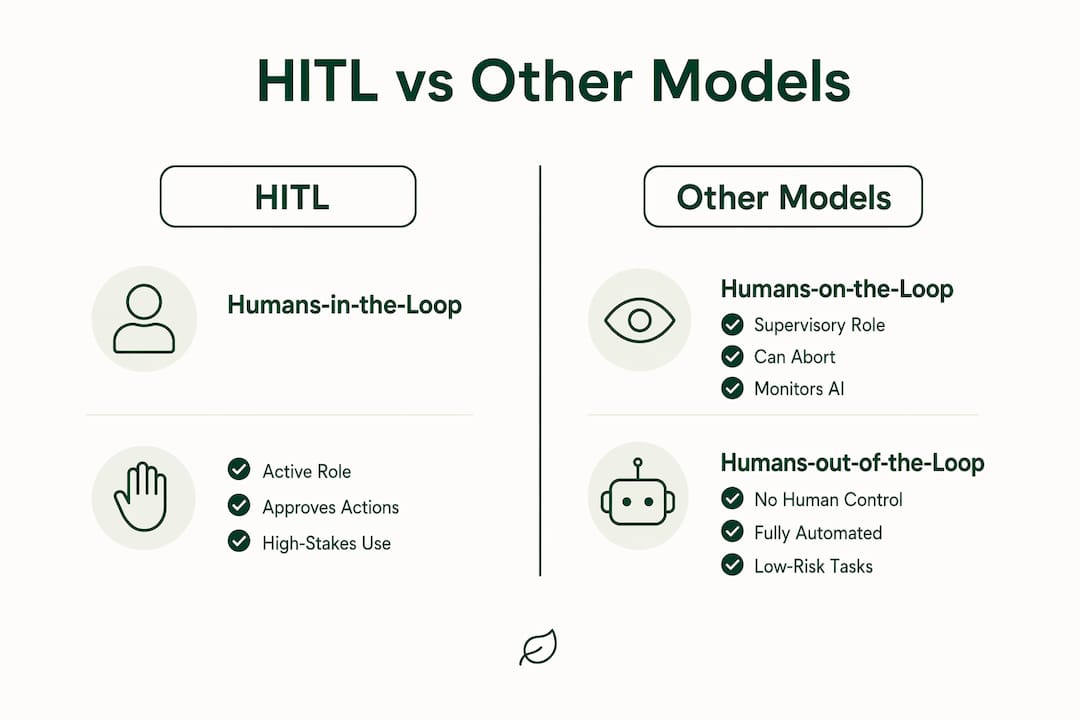
How does HITL compare to humans-on-the-loop and humans-out-of-the-loop?
These three models describe how much control a human retains over an AI system’s actions. The differences matter enormously in regulated industries and anywhere accountability is legally defined.
| Model | Human role | Decision authority | Typical use case |
|---|---|---|---|
| Humans-in-the-loop | Active participant | Human approves or corrects before action | Medical diagnosis, loan approvals, content moderation |
| Humans-on-the-loop | Supervisor with abort capacity | Human can intervene but system acts by default | Cybersecurity monitoring, drone operations |
| Humans-out-of-the-loop | No real-time involvement | System acts fully autonomously | High-frequency trading, spam filtering |
Active human decision-making defines HITL, while humans-on-the-loop supervise and can abort, and humans-out-of-the-loop involve no human action at all. The accountability implications are significant: in domains like medical diagnosis and autonomous weapons, HITL is considered the only defensible model precisely because it keeps a human responsible for each consequential output.
Regulatory frameworks are increasingly codifying these distinctions. The EU AI Act, for instance, requires human oversight for high-risk AI applications, a requirement that maps directly onto the HITL model. U.S. federal agencies have issued similar guidance for AI use in benefits determinations and law enforcement.
What does good HITL system design actually look like?
Designing a HITL workflow that works in production is harder than it sounds. The most common failure mode is not a bad AI model. It is a poorly designed handoff between the automated system and the human reviewer.
Key design principles:
- Configure wait states with explicit timeouts. A workflow that pauses for human input must have a defined timeout. Lack of default timeout settings can cause operational delays if reviewers do not respond, making careful design of wait states essential for reliability.
- Surface triggers in the tools people already use. Routing a HITL prompt to a separate dashboard that reviewers rarely open defeats the purpose. Sending it to Slack or Microsoft Teams, where the reviewer already works, dramatically improves response rates.
- Minimize cognitive load at the decision point. The human reviewer should see exactly the context they need, nothing more. Overloading the interface with raw data slows decisions and increases errors.
- Define escalation paths. If the primary reviewer does not respond within the timeout window, the workflow should escalate automatically rather than stall.
- Log every human decision. Audit trails are not optional in regulated environments. Every approval, rejection, or override should be timestamped and attributed.
Common pitfalls to avoid:
- Treating HITL as an afterthought bolted onto an existing automation
- Routing all outputs to human review regardless of confidence score, which creates reviewer fatigue
- Failing to close the feedback loop so human corrections actually update the model
IT operations teams that combine automated workflows with human approvals and integrate with communication tools like Slack and Teams consistently report better compliance and governance outcomes than teams relying on isolated review dashboards.
Common misconceptions about human-in-the-loop systems
A few persistent misunderstandings make HITL harder to implement well.
- Myth: HITL is a fallback for when automation fails. HITL is a design choice, not a safety net. Systems built with HITL from the start collect better training data and reach higher accuracy faster than those that add human review only after problems emerge.
- Myth: HITL means a human reviews everything. Selective engagement is the point. Confidence thresholds, risk scores, and exception rules determine which outputs get human review. Reviewing everything defeats the efficiency gains of automation.
- Myth: HITL slows down automation. A well-designed HITL workflow with proper timeouts and contextual routing adds minimal latency to the overall process. The bottleneck is almost always a poorly designed handoff, not the human review itself.
- Myth: HITL is only relevant for large enterprises. Any business running automated decisions that affect customers, compliance, or finances benefits from at least some human oversight checkpoints.
- Myth: Adding humans to AI always improves results. Research shows this is not universally true, which is why thoughtful scoping of where human involvement adds value is the real skill.
HITL as a design philosophy treats human judgment as an integrated operational mode, not a temporary exception, which is a fundamentally different mindset than treating automation as the default and humans as the override.
What the research actually says about human-AI collaboration
The honest picture is more nuanced than most HITL advocates admit. A meta-analysis published in Nature Human Behaviour found that human-AI combinations outperform humans working alone on average, but they often underperform compared to AI working alone, particularly in decision-making tasks. Synergy, where the combination beats both humans and AI independently, is most reliably achieved in creative and content generation work.
“Combinations of humans and AI work best when each party can do the thing they do better than the other. We found humans excel at subtasks involving contextual understanding and emotional intelligence, while AI systems excel at subtasks that are repetitive, high-volume, or data-driven.”
— Thomas W. Malone, MIT Sloan professor and director of the MIT Center for Collective Intelligence, via MIT Sloan Management Review
The practical implication: HITL design requires honest scoping. Putting humans in the loop on tasks where AI already outperforms humans can actually reduce overall accuracy, because people tend to defer to the AI inconsistently rather than systematically. The MIT research recommends A/B testing across human-only, AI-only, and combined workflows before committing to a HITL architecture for any given task.
Where HITL consistently adds value: high-context decisions, novel situations outside the model’s training distribution, and any output where a wrong answer carries legal, financial, or safety consequences.
Key Takeaways
Human-in-the-loop systems deliver the most value when human judgment is applied selectively at high-stakes, high-uncertainty decision points rather than uniformly across all automated outputs.
| Point | Details |
|---|---|
| HITL is a design choice | Human involvement is built into the workflow architecture from the start, not added after automation fails. |
| Selective engagement matters | Confidence thresholds and risk scores determine which outputs get human review, preserving efficiency. |
| Wait states need timeouts | Workflows that pause for human input must have explicit timeout configurations to prevent indefinite stalls. |
| Synergy requires honest scoping | Human-AI combinations outperform humans alone but can underperform AI alone in decision-making tasks. |
| Context determines value | HITL adds the most value in high-context, novel, or legally consequential decisions outside a model’s training distribution. |
FAQ
What is human-in-the-loop in AI?
Human-in-the-loop (HITL) is an AI design model where humans actively intervene at defined workflow stages to guide decisions, correct errors, and provide oversight. It combines human judgment with machine efficiency to improve accuracy and ethical accountability.
How does HITL differ from humans-on-the-loop?
In a HITL system, a human must approve or correct an output before the system acts. In a humans-on-the-loop model, the system acts by default and a human can intervene or abort, but is not required to approve each action.
Does adding humans to AI always improve performance?
Not always. Research from the MIT Center for Collective Intelligence found that human-AI combinations outperform humans alone on average but often underperform AI alone, especially in decision-making tasks. Synergy is strongest in creative and content generation work.
What is a “wait node” in a HITL workflow?
A wait node is a configured pause point in an automated sequence where the system holds state until a human responds. Without a defined timeout, a missing response can stall the entire workflow indefinitely.
Is human-in-the-loop AI only for large enterprises?
No. Any business running automated decisions that affect customers, compliance records, or financial transactions benefits from HITL checkpoints. The scale of implementation varies, but the principle applies across business sizes and industries.