
TL;DR:
- Klaviyo is ideal for ecommerce and regulated industries that require event-based data and advanced automation. Mailchimp suits smaller businesses seeking quick setup, multiple channels, and lower costs, but lacks the depth for complex compliance needs. Choosing the right platform depends on your team’s data literacy, compliance requirements, and automation goals.
Klaviyo is the stronger choice when behavioral data and revenue attribution are central to your operation. Mailchimp wins when you need fast setup, broad marketing channels, and lower entry cost. For regulated or complex businesses where compliance, custom data pipelines, and AI-driven automation matter, the decision goes deeper than features.
Quick recommendation matrix:
- Data-driven ecommerce or regulated workflows → Klaviyo (event-based data model, predictive analytics, warehouse-native integrations)
- General SMB, newsletters, or multi-channel marketing → Mailchimp (faster setup, polished templates, lower entry pricing)
- Custom compliance automation or complex data pipelines → Consider an implementation partner like Cannatract
Table of Contents
- How does Klaviyo vs Mailchimp compare across key dimensions?
- Which platform gives you deeper automation and AI for lifecycle marketing?
- What do data models and integrations mean for regulated stacks?
- What compliance and deliverability risks should U.S. regulated businesses know?
- How do pricing models and total cost of ownership compare?
- How should you evaluate which platform fits your team?
- What does a migration checklist look like in practice?
- When does hiring an implementation partner make sense?
- Key Takeaways
- The case for picking the right tool, not the popular one
- A free automation audit covers the gaps both platforms leave open
- Useful sources
- FAQ
How does Klaviyo vs Mailchimp compare across key dimensions?
| Dimension | Klaviyo | Mailchimp |
|---|---|---|
| Best for | Ecommerce / regulated DTC | General SMB / newsletters |
| Starting price | around $20/mo for 500 contacts | around $13/mo (Essentials plan for 500 contacts) |
| Automation depth | Event-driven, multi-step flows | Customer Journey Builder, template-heavy |
| AI capabilities | Predictive CLV, churn risk, lifecycle | Content creation, send-time optimization |
| Data model | Event-based (real-time streams) | Profile-based |
| Segmentation | Behavioral + predictive, real-time | Behavioral + predictive (paid tiers) |
| Integrations | 350+ native, BigQuery/Snowflake | Broad general-purpose marketplace |
| SMS | Native, unified with email flows | Add-on, limited |
| Deliverability | Strong for ecommerce senders | Solid across general use |
| Ease of use | Steeper learning curve | Faster onboarding, friendlier UI |
| Support | Email + chat (paid); customer success managers | Email + chat; phone at $350+/mo |
Pricing scenarios at a glance:
| List size | Klaviyo (email only) | Mailchimp (Standard) |
|---|---|---|
| 500 contacts | around $20/mo | around $13/mo |
| 15,000 contacts | approximately $350/mo | approximately $200/mo |
| 30,000 contacts | approximately $500/mo | approximately $310/mo |
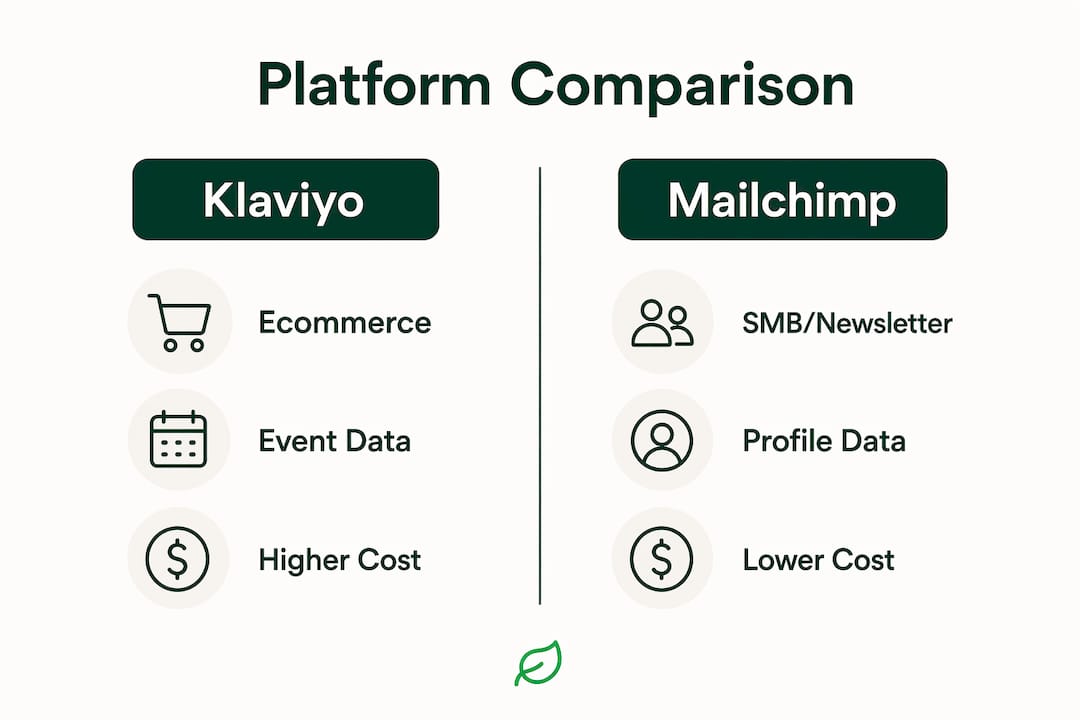
Klaviyo’s event-based data model ingests real-time behavioral streams. Mailchimp operates on a profile-based model, which is simpler to manage but shallower for compliance telemetry and custom AI features.

Which platform gives you deeper automation and AI for lifecycle marketing?
Klaviyo provides deeper lifecycle automation for regulated and revenue-focused teams. Its flow builder supports conditional splits, predictive lifetime value triggers, and cross-channel suppression logic. Mailchimp’s Customer Journey Builder covers welcome series and basic cart recovery well, but its trigger depth and ecommerce presets don’t match Klaviyo’s.
Key differences that matter in practice:
- Flow complexity: Klaviyo supports multi-step, event-triggered flows with A/B testing inside a single automation. Mailchimp offers basic conditional logic.
- Channel unification: Klaviyo runs email and SMS from one flow with unified reporting. Mailchimp’s SMS feels bolted on.
- Predictive CLV: Klaviyo’s AI estimates customer lifetime value, next purchase date, and churn risk natively. Mailchimp doesn’t offer equivalent lifecycle intelligence.
- AI use cases: Mailchimp’s AI speeds content creation and send-time decisions. Klaviyo’s AI drives targeting and lifecycle decisions.
- Send-time optimization: Both offer it; Klaviyo’s is tied to behavioral data, Mailchimp’s is more generalized.
Pro Tip: Match your automation ceiling to your team’s actual data maturity. Buying Klaviyo without a data-literate operator is one of the most common procurement mistakes in this category. If your team can’t maintain event schemas, Mailchimp’s simpler model will outperform an underused Klaviyo build.
What do data models and integrations mean for regulated stacks?
For regulated businesses, event-based systems give finer-grain control over compliance signals and custom AI models. Klaviyo ingests custom events from BigQuery and Snowflake, enabling segmentation on proprietary telemetry, not just email behavior.
Required capabilities for regulated use cases:
- Warehouse-native connectors (BigQuery, Snowflake) for custom event ingestion
- Custom event schemas with audit-ready timestamps
- Consent metadata stored at the contact level
- Exportable event histories for audit trails
- Fine-grain suppression lists tied to consent status
Mailchimp’s profile-based model handles standard consent capture but lacks the depth for custom telemetry or warehouse-native pushes. If your compliance program requires proving exactly when a subscriber consented, what event triggered a message, and what data was used in targeting, Klaviyo’s architecture is the more defensible choice.
If you’re evaluating how AI-driven analytics apply to your marketing signals, the data model you choose upstream determines what’s possible downstream.
What compliance and deliverability risks should U.S. regulated businesses know?
Both platforms are capable for most U.S. businesses, but they differ on the controls and telemetry that regulated programs require. Event-driven platforms that emphasize list hygiene and reputation management tend to show stronger inbox placement for high-volume ecommerce senders.
Compliance checklist to verify with any ESP before signing:
- Data retention policies and configurable retention windows
- Consent capture mechanism and where consent timestamps are stored
- Exportable audit logs (who received what, when, based on which segment)
- Privacy controls: CCPA data deletion, opt-out propagation speed
- SOC 2 Type II or ISO 27001 attestations
- Data residency options for sensitive industries
Questions to ask during procurement:
- Can you export a full event history for a single contact, including suppression events?
- Where is consent metadata stored, and is it exportable in a machine-readable format?
- What is your SLA for honoring opt-out requests?
- Do you offer dedicated IP warming for high-volume regulated senders?
- What compliance documentation do you provide for audit support?
How do pricing models and total cost of ownership compare?
Klaviyo’s event-based pricing is more predictable for large, single-list programs. Mailchimp’s audience duplication behavior is the bigger TCO risk: contacts appearing in multiple audiences are counted multiple times, which inflates costs on multi-segment programs.
Hidden cost traps to watch:
- Mailchimp: Duplicate contacts across audiences, feature gates on advanced automation (Standard and Premium tiers required), SMS as a separate add-on
- Klaviyo: Steep per-profile scaling, separate SMS credit billing, API event volume can increase costs on high-event-rate integrations
Scenario A — Mid-size list with heavy SMS (10,000 contacts, 20,000 SMS/mo): Klaviyo’s email plan runs roughly $150/mo at that list size; SMS credits add a separate line. Mailchimp’s Standard plan at 10,000 contacts runs roughly $100/mo, with SMS billed additionally. The gap narrows when SMS volume is high on either platform.
Scenario B — Large list with many custom events (50,000 contacts, complex segmentation): Klaviyo runs approximately $700/mo for email alone at 50,000 contacts. Mailchimp’s comparable tier is lower, but if contacts are split across multiple audiences, effective billing can climb unexpectedly.
How should you evaluate which platform fits your team?
Start with team maturity, then data model, then compliance needs, then automation requirements, then cost. Buying in the wrong order is how teams end up with a powerful tool they can’t operate.
- Assess team data literacy. Can your team maintain event schemas and interpret flow analytics? If not, Mailchimp’s guided model reduces operational risk.
- Audit your data sources. Do you need to ingest custom events from a warehouse or compliance system? Klaviyo is the only viable option.
- Map your compliance requirements. List the specific audit, consent, and data residency requirements your legal team mandates.
- Define your automation ceiling. What flows must you run at launch vs. in 12 months? Don’t buy for a roadmap you won’t execute.
- Model TCO at your actual list size. Run the numbers at your current list and at 2x growth. The cheaper entry price rarely stays cheaper at scale.
Red flags during trials:
- The vendor can’t show you a sample audit log export
- Consent timestamps aren’t stored at the event level
- Support can’t answer questions about data residency without escalation
- Migration documentation is vague or non-existent
Independent testing confirms Klaviyo gives more control for segmentation and lifecycle flows, while Mailchimp’s editor is faster for designing campaigns quickly. Match the tool to what your team will actually use daily.
What does a migration checklist look like in practice?
The lowest-risk automations to deploy first after migration are: welcome series with consent capture, critical transactional flow replication, cart recovery with consent tracking, and automated suppression list syncing.
Migration checklist:
- Audit current lists (week 1): Export all contacts, tag consent status, identify duplicates, and document active flows.
- Clean and deduplicate (week 1): Remove unsubscribes, hard bounces, and contacts without valid consent records.
- Map custom fields and events (week 1–2): Document every custom property and event your current platform tracks. Developers own this step.
- Configure new platform (week 2): Set up sending domain authentication (SPF, DKIM, DMARC), import cleaned list, and configure consent capture forms.
- Replicate critical flows (week 2–3): Rebuild transactional and welcome flows first. Cart recovery and win-back flows come second.
- Parallel-run and validate (week 3–4): Run both platforms simultaneously on a small segment to confirm deliverability and flow logic before full cutover.
- Full cutover and monitor (week 4): Decommission the old platform only after 7 days of clean parallel performance.
Marketers handle content and flow logic. Developers handle event schema mapping, domain authentication, and warehouse connectors. Plan for 3–4 weeks total for a mid-size list with moderate complexity.
When does hiring an implementation partner make sense?
Hire an implementation partner when your team lacks data engineering capacity, your compliance requirements are non-standard, or time-to-value pressure is real. Trying to self-implement a complex event-driven stack without those resources typically costs more in lost time than the agency fee.
Pro Tip: Validate your automation architecture before you build. Tools like Spark Concept’s idea checker can help you pressure-test your event schema and flow logic before committing to a platform or a build.
A typical Cannatract engagement for a regulated client runs 2–4 weeks on a fixed-scope basis: audit your current workflow and data stack, build the automation system or ESP integration, hand off with documentation, and optionally move to an ongoing management arrangement. Cannatract’s AI automation services cover custom event ingestion, compliance workflow automation, and CRM integrations, which are the exact gaps that cause self-implementations to stall.
Key Takeaways
Klaviyo wins for data-driven ecommerce and regulated workflows; Mailchimp wins for fast setup, broad marketing, and lower entry cost at smaller list sizes.
| Point | Details |
|---|---|
| Platform fit by data model | Klaviyo’s event-based model suits regulated and ecommerce stacks; Mailchimp’s profile-based model suits general SMBs. |
| Pricing diverges at scale | Klaviyo runs approximately $700/mo at 50,000 contacts; Mailchimp’s audience duplication can inflate costs on multi-segment programs. |
| AI splits by use case | Mailchimp’s AI accelerates content creation; Klaviyo’s AI drives predictive targeting and lifecycle decisions. |
| Compliance checklist first | Verify consent metadata export, audit logs, and data residency before signing with any ESP. |
| Cannatract as implementation path | Cannatract delivers custom ESP integrations and compliance automation in 2–4 weeks on a fixed-scope basis. |
The case for picking the right tool, not the popular one
The Klaviyo vs Mailchimp debate gets framed as a simple ecommerce vs SMB split, but that framing misses the real decision for regulated businesses. The question isn’t which platform has more features. It’s which platform’s data architecture matches the compliance and reporting obligations you already have.
Mailchimp’s profile-based model is genuinely good for what it was built to do. The mistake is using it as a proxy for a compliance-ready data layer it was never designed to be. Klaviyo’s event model is powerful, but it demands a team that can maintain event schemas and interpret flow analytics. Buying the more complex tool without that capacity doesn’t improve outcomes. It creates technical debt.
The middle path most teams overlook: start with a clear audit of what your compliance program actually requires from an ESP, then match the platform to those requirements, not to a feature checklist. If the requirements exceed what either platform handles natively, that’s the signal to bring in an implementation partner before you sign a contract, not after you’ve already migrated.
A free automation audit covers the gaps both platforms leave open
If you’ve read this far, you’re likely dealing with a workflow that neither Klaviyo nor Mailchimp solves cleanly out of the box. Custom compliance automation, event-driven segmentation tied to proprietary data, or CRM integrations that require real engineering work fall outside what either platform’s native setup handles.
Cannatract builds and runs custom AI agents and automation systems for businesses in regulated and complex industries. A free automation audit covers your current workflow costs, TCO across platform options, and a migration plan with realistic timelines. You get a fixed quote before any work starts, and most systems ship in 2–4 weeks. Book your free audit at cannatract.co and find out exactly what your current stack is costing you.
Useful sources
- Klaviyo vs. Mailchimp (G2/Learn) — Practical UI and segmentation testing; backs claims about ease of use and lifecycle flow depth.
- Mailchimp vs Klaviyo (SendPulse) — AI feature comparison and platform positioning; backs the content-vs-lifecycle AI split.
- Klaviyo vs Mailchimp (EmailToolTester) — Pricing model analysis and TCO traps; backs audience duplication and scaling cost claims.
- Klaviyo vs Omnisend (Ecommerce Times) — Warehouse-native integrations, predictive analytics depth, and procurement risk; backs event-model and compliance claims.
- Klaviyo vs Mailchimp (Mailercloud) — Pricing scenarios at 15K and 30K contacts; backs the pricing comparison table.
FAQ
Which is better for ecommerce, Klaviyo or Mailchimp?
Klaviyo is the stronger choice for ecommerce. Its pre-built flows, revenue attribution, and event-based segmentation are built specifically for store-driven revenue, while Mailchimp’s ecommerce features are solid but shallower.
How does Klaviyo pricing compare to Mailchimp at scale?
Klaviyo costs roughly $350/mo at 15,000 contacts versus Mailchimp’s $200/mo, and approximately $500/mo at 30,000 contacts versus Mailchimp’s $310/mo. Klaviyo’s SMS billing is separate, which increases total cost further at high message volumes.
Which platform is better for compliance-heavy regulated industries?
Klaviyo’s event-based data model gives better control over consent metadata, audit logs, and custom telemetry, which are the features that matter most during compliance audits. Verify specific data residency and export capabilities with each vendor before committing.
When should you hire an implementation partner instead of self-implementing?
Hire a partner when your team lacks data engineering capacity, your compliance requirements are non-standard, or you need to go live quickly. Cannatract delivers custom ESP integrations and compliance automation in 2–4 weeks on a fixed-scope basis.
Can Mailchimp handle advanced automation for complex businesses?
Mailchimp’s Customer Journey Builder covers welcome series, re-engagement, and basic cart recovery well, but it lacks the event-trigger depth and predictive segmentation that complex or regulated workflows typically require.