TL;DR:
- Klaviyo offers deep segmentation and predictive analytics suited for data-driven teams with technical expertise. Omnisend provides rapid multichannel deployment with bundled SMS, ideal for lean teams seeking predictable costs. Choosing depends on your team’s skills, compliance needs, and how you plan to automate customer engagement.
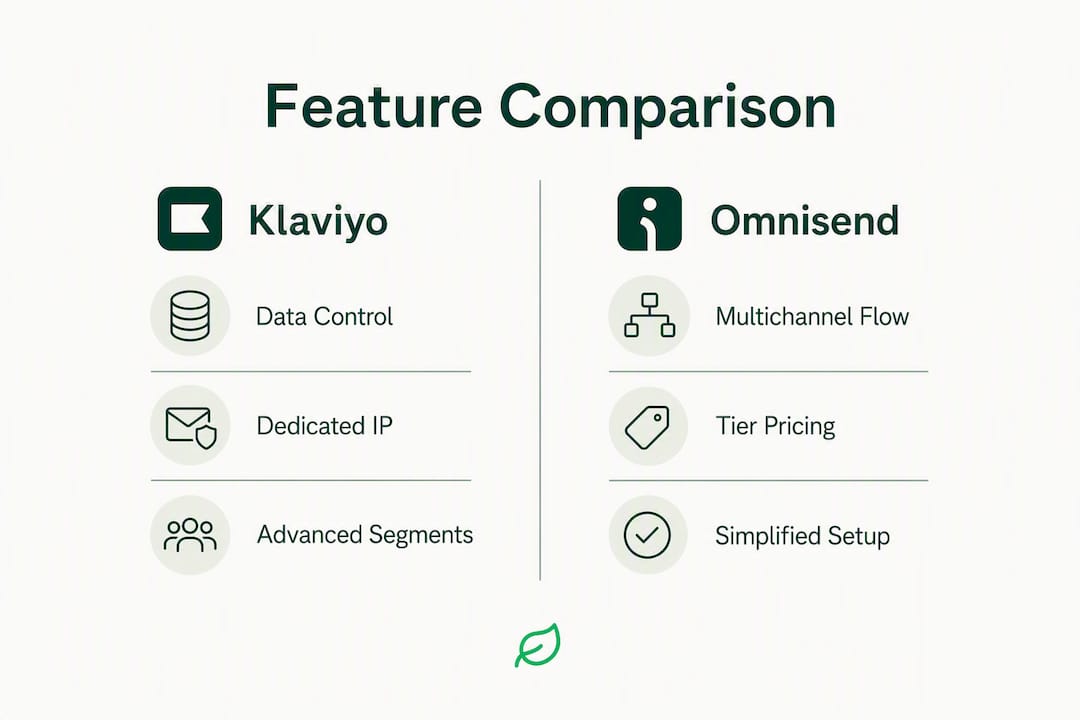
Klaviyo is the stronger choice when your team has dedicated email specialists and needs granular behavioral segmentation, predictive analytics, and a deep integration surface for AI-driven workflows. Omnisend wins when you need fast multichannel deployment — email, SMS, and web push in a single flow — at a more predictable cost. Neither platform is universally better; the right call depends on your team’s technical capacity, compliance requirements, and how you plan to use automation.
Two trade-offs define this decision:
- Klaviyo delivers deeper segmentation and predictive properties (predicted LTV, next order date) but requires more technical skill and carries higher costs as your contact list grows.
- Omnisend bundles email, SMS, and web push credits into one plan, making multichannel spend more predictable, but its integration catalog and segmentation depth are narrower.
Before you commit to either platform, confirm your compliance posture. SMS campaigns must satisfy TCPA consent requirements; all commercial email must meet CAN-SPAM standards. If your stack also includes regulated data (health, cannabis, financial), map your data retention and event schema requirements first. Cannatract’s free automation audit covers exactly that before any platform migration begins.
Table of Contents
- How do Klaviyo and Omnisend compare across key dimensions?
- What makes automation and segmentation different between the two?
- How should you calculate the real cost of each platform?
- Which team structure fits Klaviyo, and which fits Omnisend?
- Does deliverability, integration depth, or reporting differ in ways that matter?
- What does a clean migration actually look like?
- Which platform should you pick for your specific situation?
- Key Takeaways
- The platform decision most teams get wrong
- Cannatract handles the migration, compliance mapping, and AI automation layer
- Useful sources
- FAQ
How do Klaviyo and Omnisend compare across key dimensions?
| Dimension | Klaviyo | Omnisend |
|---|---|---|
| Best for | Data-driven DTC brands, complex stacks | Lean teams, fast multichannel launch |
| Pricing model | Active-profile billing + separate SMS usage | Plan-based with bundled SMS/push credits |
| Automation & segmentation | Granular behavioral + predictive properties | Native multichannel flows, simpler logic |
| Multichannel support | Email + SMS (billed separately) | Email, SMS, web push in one workflow |
| Integrations | ~350 native integrations | ~130–200+ native integrations |
| Reporting & analytics | Predictive forecasts, peer benchmarks | Per-step revenue attribution, A/B variant tracking |
| Ease of use | Steeper learning curve | Faster onboarding, commerce sync in minutes |
| Deliverability & compliance | Shared + dedicated IPs, advanced suppression | Shared IPs, solid suppression handling |
| Onboarding & support | Extensive docs; support quality varies by plan | Guided setup; first campaign in 15–20 minutes |
A few cells worth clarifying:
- Klaviyo’s SMS is billed as a separate usage layer on top of your email plan, which adds cost variability.
- Omnisend’s Pro plan bundles SMS credits proportional to plan cost, making monthly budgeting more straightforward.
- Klaviyo’s ~350 native integrations favor teams running complex tech stacks with custom data pipelines.
What makes automation and segmentation different between the two?
Klaviyo is built for data-driven teams that need to slice audiences by behavioral signals: purchase frequency, predicted next order date, predicted LTV, and custom event attributes. Those predictive properties feed directly into AI-driven workflows — for example, triggering a win-back sequence only when a customer’s predicted LTV crosses a threshold, or routing high-value segments to a dedicated rep via a CRM integration. For regulated industries, Klaviyo’s custom attributes and event schemas also make it easier to log consent events and maintain an auditable data trail.

Omnisend takes a different approach. Its native multichannel flow model lets you build fallback logic across email, SMS, and web push without stitching together separate tools. A customer who doesn’t open an email gets an SMS; if that goes unread, a push notification fires. For a lean operations team, that built-in fallback is faster to configure and easier to maintain than a custom multi-platform sequence.
Pro Tip: If your team plans to feed platform data into an external AI model or a data warehouse for advanced LTV modeling, Klaviyo’s API surface is the better foundation. If you need platform-native predictions and your team can’t staff a data engineer, Omnisend’s built-in attribution per automation step covers most use cases without the overhead. Cannatract’s AI automation builds can layer custom agents on top of either platform.
How should you calculate the real cost of each platform?
Klaviyo bills by active profiles, and that number climbs faster than most teams expect once you factor in lapsed customers who haven’t been suppressed. SMS usage is a separate line item, billed by message volume. Omnisend’s plan-based pricing bundles SMS credits, so your monthly spend is more predictable at common e-commerce scales. At a common e-commerce scale, multiple analyses show Omnisend pricing is generally lower than Klaviyo’s, though the gap narrows if you need Omnisend’s higher-tier features.
| Cost driver | Klaviyo | Omnisend |
|---|---|---|
| Contact count | Scales billing directly | Tier-based, less sensitive |
| SMS volume | Separate usage billing | Bundled credits on Pro plan |
| Dedicated IP | Available, adds cost | Not publicly listed |
| API call volume | Included; warehouse exports add cost | Included in plan |
| Data retention / warehouse | External cost if exporting | External cost if exporting |
| Migration labor | typically higher for Klaviyo than Omnisend |
Pro Tip: Hidden TCO items most teams miss: attribution rework after migration (plan for 2–4 weeks of reporting discrepancies), third-party connector fees if your CRM or POS isn’t natively supported, and the staff hours to rebuild event schemas. Budget these before signing.
Which team structure fits Klaviyo, and which fits Omnisend?
Analysts consistently tie platform choice to team composition, not just feature lists. Here’s how that maps in practice.
Profile A — Established DTC brand with dedicated specialists: If you have an email strategist, a data engineer who can manage event schemas, and a CRM admin who can maintain integrations, Klaviyo pays off. The predictive properties and deep API surface justify the learning curve when someone owns them full-time.
Profile B — Lean or cross-functional team: If your operations manager also runs campaigns and your “email person” wears three other hats, Omnisend’s guided setup and bundled channels reduce the cognitive load. Omnisend commonly syncs product inventory, customer lists, and order history automatically, so a first campaign can go out within 15–20 minutes of signup.
Readiness checklist before committing:
- Do you have someone who can own segmentation logic and keep it current?
- Can your team map and maintain custom event schemas?
- Do you have a compliance officer or process for TCPA/CAN-SPAM sign-off on SMS flows?
- Is your CRM or POS natively supported, or will you need a custom connector?
- Can you absorb a 2–4 week reporting normalization period post-migration?
If you answered “no” to three or more of those, Omnisend is the lower-risk starting point. If you answered “yes” across the board, Klaviyo’s ceiling is higher.
Does deliverability, integration depth, or reporting differ in ways that matter?
For regulated operations, deliverability controls matter more than inbox placement rates alone. Klaviyo offers both shared and dedicated IP options; dedicated IPs give you full control over sender reputation, which is worth the added cost if you send high volumes or operate in a regulated category where a spam complaint could trigger a compliance review. Both platforms handle suppression lists and unsubscribe processing, but Klaviyo’s suppression management is more granular.
On integrations, Klaviyo’s catalog of native integrations is significantly larger than Omnisend’s; Omnisend lists between ~130–200+ depending on source. This is a real difference for teams running Shopify Plus alongside a custom ERP, a loyalty platform, and a data warehouse. For a simpler stack, Omnisend’s integrations cover the common cases without the configuration overhead. Teams evaluating analytics exports should also consider pairing either platform with a BI tool; Cannatract’s Tableau vs Power BI analysis covers that layer.
Pro Tip: Before migration, audit every dataflow that touches PII: where it originates, where it lands, and how long it’s retained. Regulated industries often discover that their ESP is storing consent records that need to move with the migration — not just contact lists.
What does a clean migration actually look like?
A structured migration prevents the most common failure modes: lost event fidelity, broken attribution, and SMS opt-out records that don’t transfer.
- Pre-migration audit (Days 1–3): Map all data sources, identify PII locations, export consent records and TCPA opt-in timestamps, and document your current event taxonomy.
- Export and cleanse (Days 3–5): Remove hard bounces, suppress unengaged contacts older than 12 months, and validate that opt-out records are complete.
- Import and configure (Days 5–10): Import lists to the new platform, rebuild core flows (welcome, abandoned cart, win-back), and map custom attributes to the new schema.
- Parallel testing (Days 10–14): Run both platforms simultaneously on a small segment. Compare attribution numbers and flag discrepancies before full cutover.
- Full cutover and normalization (Days 14–28): Expect a 2–4 week normalization period where reporting numbers diverge from historical baselines. This is normal; it reflects attribution model differences, not data loss.
Common pitfalls:
- Moving via CSV exports loses behavioral event history — you’ll need to rebuild event schemas from scratch on the new platform.
- SMS opt-out records must transfer explicitly; a missed suppression can trigger a TCPA violation.
- Attribution windows differ between platforms, so revenue numbers will look different even for identical campaigns.
Which platform should you pick for your specific situation?
- Small or bootstrapped store: Start with Omnisend’s free plan, which includes multichannel features beyond what Klaviyo’s free tier offers. Upgrade when SMS volume justifies it.
- Mid-market growth brand: Omnisend at 10,000 contacts is materially cheaper and covers most multichannel needs. Confirm: does your team have bandwidth to manage Klaviyo’s segmentation depth before paying for it?
- Enterprise DTC on Shopify Plus: Klaviyo’s integration depth and predictive analytics justify the cost if you have the staff. Run a 2-week proof-of-concept migration before committing.
- Regulated or complex operations needing auditability: Klaviyo’s custom event schemas and dedicated IP options give you more control over data trails and sender reputation. Confirm your compliance officer has reviewed TCPA consent flows before activating SMS. Schedule a Cannatract automation audit to map dataflows before platform selection.
Key Takeaways
Klaviyo fits teams with technical depth and complex data needs; Omnisend fits lean teams that need fast, predictable multichannel campaigns at lower cost.
| Point | Details |
|---|---|
| Match platform to team | Klaviyo requires dedicated specialists; Omnisend works for cross-functional teams without a data engineer. |
| Budget for SMS separately on Klaviyo | Klaviyo bills SMS as a usage layer; Omnisend bundles credits, making monthly costs more predictable. |
| Plan for 2–4 week normalization | Attribution and reporting discrepancies are normal post-migration; build this window into your project plan. |
| Audit compliance before SMS launch | TCPA consent records and CAN-SPAM compliance must be verified before activating any SMS automation. |
| Cannatract for complex migrations | Cannatract delivers compliant migrations and AI automation builds in 2–4 weeks with a fixed quote and free initial audit. |
The platform decision most teams get wrong
The Klaviyo vs Omnisend debate gets framed as a features race, but the real question is whether your team will actually use what you’re paying for. Klaviyo’s predictive properties and deep API surface are genuinely powerful — but teams routinely underestimate the onboarding effort, and underutilized features don’t generate revenue. Omnisend’s bundled multichannel model looks simpler on paper, but its attribution granularity per automation step is strong enough that some operators actually prefer it over Klaviyo’s higher-level reports.
The sharper question for regulated and complex operations isn’t which platform has more features. It’s which platform your team will configure correctly, maintain under compliance pressure, and actually connect to your CRM, POS, and data warehouse without a six-month integration project. That answer depends on your staffing, your stack, and your compliance requirements — not on a feature checklist.
For teams in regulated industries, the customer journey automation layer matters as much as the ESP itself. The platform is just the send engine; the real value comes from the workflows, the data model, and the compliance controls built around it.
Cannatract handles the migration, compliance mapping, and AI automation layer
Klaviyo and Omnisend both require real configuration work to perform at the level their marketing materials describe. Cannatract delivers that configuration — plus the AI automation layer on top — in 2–4 weeks, with a fixed quote and a free initial audit that maps your dataflows, compliance requirements, and integration dependencies before any platform decision is finalized.
Relevant services for this decision:
- Migration and data mapping: Export, cleanse, schema rebuild, and parallel testing with compliance sign-off on TCPA/CAN-SPAM flows.
- AI agent and workflow automation: Custom agents that trigger on platform events, route leads, and feed your CRM or data warehouse without manual intervention.
- Compliant e-commerce integrations: Commerce-linked builds that connect your ESP to Shopify, POS, and ERP systems with documented data trails.
- Regulated-industry marketing: Compliant campaign creative and automation for industries where a generic agency setup creates legal exposure.
Book your free automation audit at cannatract.co and get a clear scope before you sign anything.
Useful sources
- Omnisend vs. Klaviyo: Best for ecommerce 2026? (Omnisend Blog) — Omnisend’s own comparison covering pricing, multichannel features, and free plan differences; useful for verifying bundled SMS credit claims.
- Klaviyo vs Omnisend (2026): Which Wins for eCommerce? (Venture Harbour) — Independent analyst comparison covering team-fit guidance, pricing crossover points, and onboarding speed; primary source for staffing and cost claims in this article.
- Omnisend vs Klaviyo: What We Learned After Testing Both (OnSaaS) — Practitioner testing report with integration catalog counts and onboarding observations.
- Klaviyo vs Omnisend: Which Wins for Ecommerce? (Drip Blog) — Covers migration risks, attribution discrepancies, and the 2–4 week normalization window; useful for migration planning.
- Cannatract — AI Automation Agency & AI Agents — Agency landing page describing the 2–4 week rapid-deploy model and free automation audit.
FAQ
Which platform is better for regulated industries?
Klaviyo gives regulated teams more control over data schemas, dedicated IP options, and custom event attributes for auditability. Confirm TCPA consent flows and data retention requirements before activating SMS on either platform.
How does Klaviyo vs Omnisend pricing differ at 10,000 contacts?
At around 10,000 contacts, multiple analyses show Omnisend is materially cheaper than Klaviyo, partly because Omnisend bundles SMS credits while Klaviyo bills SMS as a separate usage layer.
How long does migrating between these platforms take?
A structured migration runs 14–28 days, including a 2–4 week normalization period where attribution and reporting numbers will differ from historical baselines before stabilizing.
Can Cannatract handle the migration and compliance setup?
Yes. Cannatract maps dataflows and compliance requirements in an initial audit, then delivers the full migration, integration build, and AI automation layer in 2–4 weeks with a fixed quote.
Does Omnisend include SMS on its free plan?
Omnisend’s free plan includes multichannel features — including SMS and web push — that Klaviyo’s free tier does not match, making it the lower-risk starting point for small stores testing multichannel campaigns.