If a vendor creates, receives, maintains, or transmits protected health information (PHI) on your behalf, a HIPAA Business Associate Agreement (BAA) is legally required. That agreement must document permitted uses and disclosures, required safeguards, breach reporting obligations, subcontractor flow-downs, and the return or destruction of PHI at termination. No BAA means no lawful PHI transfer, regardless of what the vendor’s privacy policy says.
Three immediate steps if you haven’t already taken them:
- Stop any PHI transfers to vendors that have not signed a BAA.
- Pull and inspect every existing BAA against the mandatory elements in 45 CFR 164.504(e).
- Run a vendor security checklist covering encryption, access controls, incident response capability, and subcontractor lists before the next contract renewal.
Pro Tip: A BAA is not a compliance checkbox. It is the legal foundation for every PHI-touching vendor relationship. Treat a missing BAA the same way you’d treat an unsigned data processing agreement under a state breach law: a live exposure, not a paperwork gap.
Key Takeaways
A valid HIPAA BAA requires specific elements under 45 CFR 164.504(e), and a signed agreement without ongoing vendor audits and technical controls does not constitute compliance.
| Point | Details |
|---|---|
| BAA trigger | Any vendor creating, receiving, maintaining, or transmitting PHI on your behalf requires a BAA before data exchange. |
| Mandatory elements | Permitted uses, safeguards, breach reporting, subcontractor flow-downs, and return or destroy PHI are all required by 45 CFR 164.504(e). |
| Direct BA liability | Under HITECH, business associates face independent OCR enforcement for Security Rule failures and breach notification violations. |
| Signed BAA is not enough | Covered entities must audit vendor technical controls and require ongoing workforce training, not just collect signatures. |
| Subcontractor chain | Business associates must obtain BAAs from their own subcontractors; covered entities should require annual attestations of compliance. |
Table of Contents
- Rapid BAA Exposure Triage for Compliance Officers
- What Counts as a Business Associate Under HIPAA?
- When Is a BAA Required, and When Are There Exceptions?
- The Legal Authority Behind BAAs: HITECH, 45 CFR, and OCR Enforcement
- Mandatory BAA Elements Required by 45 CFR 164.504(e)
- Security Rule Obligations Your BAA Must Reflect
- Subcontractor BAAs and Managing Downstream Risk
- Breach Notification: What Business Associates Must Report and When
- Vendor Due Diligence and BAA Negotiation: A Practical Checklist
- Common BAA Mistakes and Vendor Red Flags
- Contract Termination, PHI Disposition, and Audit Rights
- Sample BAA Clauses and Where to Find HHS-Approved Language
- A Practitioner’s Take on Negotiating BAAs with Tech Vendors
- Sources
- FAQ
Rapid BAA Exposure Triage for Compliance Officers
Before you read the full legal analysis, map your current exposure. Most organizations discover gaps not in their primary EHR vendor relationship but in the surrounding ecosystem: website tools, analytics platforms, scheduling widgets, and payment processors.
Vendor mapping: who touches PHI on your systems?
- Patient scheduling and appointment platforms
- Cloud hosting providers where ePHI is stored or processed
- Website form handlers, chat widgets, and intake tools
- Analytics and tracking vendors that receive data from authenticated patient portals
- Medical billing and claims processors
- Transcription and dictation services
- Call centers handling patient inquiries
- Email marketing platforms used for patient communications
- Payment processors that see patient account data
Immediate mitigations when you find an unprotected PHI flow:
- Halt the data transfer or disable the integration until a BAA is in place.
- Route PHI through a compliant intermediary if the business function cannot pause.
- Document the gap, the date discovered, and the remediation owner.
Escalation path: Legal reviews and signs the BAA. IT validates the vendor’s technical controls. Procurement flags the vendor in the contract management system. The vendor owner is accountable for follow-up within a defined window, typically 30 days.
Pro Tip: Three quick signals that a vendor is likely a business associate: they have persistent access to ePHI (not just incidental), they store or process PHI in their own systems, or their service would be impossible to perform without accessing PHI. If any one of those is true, get a BAA before the next data exchange.

According to HIPAA Journal, many organizations treat a signed BAA as sufficient and neglect vendor audits and continuous workforce training, which is a leading cause of compliance failures.
What Counts as a Business Associate Under HIPAA?
A business associate is any person or entity that performs functions or activities on behalf of a covered entity that involve creating, receiving, maintaining, or transmitting PHI. The relationship is defined by function, not by job title or contract type.
Common examples that clearly require a BAA:
- Medical billing and coding companies
- Cloud storage providers hosting ePHI
- EHR software vendors with persistent data access
- Transcription services processing clinical notes
- Call centers handling patient inquiries
- Scheduling platforms that store appointment and patient data
- Data analytics vendors processing patient records
Less obvious examples that still require a BAA:
- Online tracking technology vendors that receive PHI from appointment scheduling pages or authenticated patient portals. HHS is explicit: if a tracking vendor receives PHI from a covered entity’s website, it is a business associate, and a cookie banner does not substitute for a BAA.
- Customer data platforms that ingest patient identifiers alongside behavioral data
- Advertising platforms receiving PHI through pixel events on health-related pages
- HIPAA-compliant website hosting providers where patient intake forms are processed
Borderline and excluded cases:
- A courier delivering paper records is generally not a business associate (incidental access, not a function performed on behalf of the covered entity).
- A janitorial company with incidental access to a waiting room is not a business associate.
- A healthcare provider treating a patient at another covered entity’s referral is not a business associate — that is a treatment disclosure.
- Internet service providers transmitting encrypted ePHI as a conduit are typically excluded.
Pro Tip: When assessing a new SaaS tool for your practice or health system, ask the vendor directly: “Do you access, store, or process PHI to deliver your service?” If the answer is yes or ambiguous, treat them as a business associate and require a BAA before go-live.
For healthcare organizations building or rebuilding their web presence, HIPAA-compliant web development must account for every third-party tool embedded in the site, not just the hosting provider.
When Is a BAA Required, and When Are There Exceptions?
The core trigger is straightforward: a BAA is required whenever a vendor creates, receives, maintains, or transmits PHI on behalf of your organization as part of a function or service. The relationship must be purposeful, not incidental.
Situations that require a BAA:
- A billing company processes claims using your patient data.
- A cloud platform stores ePHI for your practice.
- A scheduling vendor manages appointment data that includes patient identifiers.
- An analytics vendor receives PHI through your patient portal’s tracking events.
Permitted disclosures that do NOT require a BAA:
- Treatment disclosures between covered entities (a hospital sending records to a specialist for direct patient care).
- Payment disclosures to health plans for claims processing when the health plan is itself a covered entity.
- Public health disclosures required by law (reporting communicable diseases to state health departments).
- Regulatory disclosures to HHS or OCR during an investigation or audit.
- Disclosures to the individual whose PHI it is.
Two concrete examples:
Requires a BAA: Your practice uses a third-party patient messaging platform to send appointment reminders. The platform stores patient names, contact information, and appointment details. That vendor creates and maintains PHI on your behalf. A BAA is required before you connect your EHR to their system.
Exception applies: Your practice refers a patient to a cardiologist and sends the patient’s records for treatment purposes. The cardiologist is a covered entity receiving PHI for direct treatment. No BAA is needed — this is a permitted treatment disclosure under the Privacy Rule.
Common edge cases where organizations get it wrong:
- Assuming a vendor’s “HIPAA-compliant” marketing claim means a BAA is in place. It does not.
- Treating a subprocessor as outside the BAA chain because the primary vendor manages them.
- Believing that de-identified data removes the BAA requirement without verifying that de-identification meets the 45 CFR 164.514 standard.
The Legal Authority Behind BAAs: HITECH, 45 CFR, and OCR Enforcement
HIPAA’s BAA requirements are grounded in statute and regulation, not just agency guidance. Understanding the precise legal basis matters when you’re drafting contracts, responding to OCR inquiries, or advising leadership on enforcement risk.
The statutory and regulatory framework:
- HIPAA Privacy Rule (45 CFR 164.504(e)): Specifies the required elements of a BAA and the implementation specifications covered entities must follow. This is the primary regulatory text for contract drafting.
- HIPAA Security Rule (45 CFR 164.308, 164.310, 164.312): Requires covered entities to obtain satisfactory assurances from business associates that ePHI will be protected through administrative, physical, and technical safeguards.
- 45 CFR 164.410: Governs breach notification obligations for business associates, including what must be reported and when.
- HITECH Act (enacted 2009, implemented through OCR’s 2013 Omnibus Rule): Extended direct HIPAA liability to business associates. Before HITECH, only covered entities faced direct OCR enforcement. After HITECH, business associates are independently liable for Security Rule failures, breach notification failures, and other specified violations.
The HHS factsheet on direct liability identifies specific categories where OCR can enforce directly against a business associate, including failure to implement Security Rule safeguards, failure to provide breach notification to the covered entity, and impermissible uses or disclosures of PHI.
What direct liability means in practice:
OCR can investigate and fine a business associate independently, without the covered entity being the primary target. A cloud vendor that suffers a breach due to inadequate encryption faces OCR scrutiny on its own, not just through its covered-entity client. Civil monetary penalties can reach into the millions of dollars depending on the level of culpability and the number of individuals affected.
Enforcement implications for contract drafting:
- Your BAA must reflect the Security Rule’s safeguard categories explicitly, not just reference “HIPAA compliance” in a general clause.
- Breach notification timelines in the BAA must align with 45 CFR 164.410 and your own OCR reporting window.
- Audit rights clauses give you the contractual basis to verify a vendor’s controls before OCR asks you to prove you did.
Pro Tip: When a vendor’s legal team pushes back on specific Security Rule language in your BAA, that resistance is itself a signal. A vendor with mature compliance controls does not object to documenting them.
Mandatory BAA Elements Required by 45 CFR 164.504(e)
Every BAA must contain specific elements to be legally valid. The HHS sample BAA provisions enumerate these requirements and provide adaptable language. The table below maps each required element to its plain-English purpose and a short sample clause.
| Regulatory Element | Plain-English Purpose | Sample Clause Starter |
|---|---|---|
| Permitted uses and disclosures | Defines exactly what the BA may do with PHI | “BA may use PHI only to perform services described in the underlying service agreement and as required by law.” |
| Prohibition on further use | Prevents unauthorized secondary use or sale of PHI | “BA shall not use or disclose PHI for any purpose not expressly permitted by this Agreement or required by law.” |
| Appropriate safeguards | Requires the BA to protect PHI from unauthorized access | “BA shall implement administrative, physical, and technical safeguards that reasonably protect PHI from unauthorized use or disclosure.” |
| Breach and security incident reporting | Obligates the BA to notify the covered entity of breaches | “BA shall report any breach of unsecured PHI or security incident to Covered Entity within [X] calendar days of discovery.” |
| Subcontractor flow-down | Extends BAA obligations to downstream vendors | “BA shall obtain a written BAA from any subcontractor that creates, receives, maintains, or transmits PHI on BA’s behalf.” |
| Access, amendment, and accounting support | Enables covered entity to fulfill individual rights requests | “BA shall provide access to PHI in its possession to Covered Entity within [X] days to enable compliance with 45 CFR 164.524.” |
| Return or destruction of PHI | Governs PHI disposition at contract end | “Upon termination, BA shall return or destroy all PHI and retain no copies, unless return or destruction is infeasible.” |
| Termination for material breach | Gives covered entity the right to terminate if BA violates the BAA | “Covered Entity may terminate this Agreement if BA materially breaches any provision and fails to cure within [X] days of notice.” |
Optional clauses worth negotiating carefully:
- Indemnification: Vendors often propose mutual indemnification. Push for asymmetric language that protects the covered entity for BA-caused breaches.
- Liability caps: Many vendor-supplied BAAs cap liability at the contract value. That cap may be inadequate relative to OCR penalty exposure.
- Audit rights: Not required by regulation but operationally critical. Require the right to request SOC 2 reports, penetration test summaries, and training records.
- Insurance minimums: Specify minimum cyber liability coverage amounts and require the BA to maintain them throughout the contract term.
Pro Tip: Never accept a vendor-supplied BAA without legal review and a technical validation pass. Vendors draft BAAs to protect themselves, not you. The permitted-uses clause and the breach-reporting timeline are the two provisions most commonly drafted in the vendor’s favor.
Security Rule Obligations Your BAA Must Reflect
The HIPAA Security Rule sets national standards for protecting ePHI and requires covered entities to obtain satisfactory assurances from business associates before allowing them to create, receive, maintain, or transmit ePHI. Those assurances belong in the BAA as specific, verifiable obligations.
Administrative safeguards to require:
- Documented risk analysis and risk management program
- Workforce training on Privacy and Security Rule requirements, conducted at hire and at least annually
- Designated security officer responsible for policy development and incident response
- Written information security policies covering access management, incident response, and contingency planning
Technical safeguards to require or verify:
- Encryption of ePHI in transit (TLS 1.2 or higher) and at rest (AES-256 or equivalent)
- Role-based access controls limiting PHI access to authorized personnel only
- Audit logging with tamper-evident records of who accessed what and when
- Multi-factor authentication for all systems storing or processing ePHI
- Automatic session timeouts on workstations and applications handling PHI
- Patch management and vulnerability remediation with defined SLAs
Physical safeguards and operational controls:
- Facility access controls for data centers and server rooms
- Workstation use policies and screen-lock requirements
- Media controls covering disposal, reuse, and accountability for devices storing ePHI
- Device management policies for mobile devices and laptops with PHI access
Quick technical-control checklist for vendor assessment:
- Request the vendor’s most recent SOC 2 Type II report and review the trust service criteria.
- Ask for a penetration test summary from the past 12 months.
- Confirm encryption architecture in writing, not just in a marketing one-pager.
- Verify that access control policies are documented and enforced through technical means, not just policy statements.
- Ask how long audit logs are retained and whether they are stored separately from production systems.
For organizations building medical billing automation workflows, every integration point with a billing processor or clearinghouse is a Security Rule touchpoint that needs both a BAA and a technical control review.
Subcontractor BAAs and Managing Downstream Risk
Business associates cannot pass PHI to a subcontractor without first obtaining a BAA from that subcontractor. This obligation flows directly from 45 CFR 164.504(e) and is one of the most frequently overlooked gaps in vendor programs.
Where liability sits in the chain:
- The covered entity is responsible for ensuring its direct business associates have BAAs in place.
- The business associate is responsible for ensuring its subcontractors have BAAs in place.
- A subcontractor that causes a breach is directly liable to OCR under HITECH, but the covered entity’s reputational and operational exposure remains real.
Common failure patterns:
- A primary vendor signs your BAA but uses a cloud infrastructure provider (their subcontractor) without a BAA in place.
- A billing company outsources coding to an offshore firm without flowing down BAA obligations.
- A SaaS platform uses third-party analytics or logging tools that receive ePHI without the covered entity’s knowledge.
Practical contract language to enforce flow-downs:
Include a clause requiring the business associate to: (1) identify all subcontractors that will receive PHI before onboarding them, (2) provide copies of executed subcontractor BAAs upon request, and (3) notify the covered entity within a defined window if a subcontractor relationship changes or terminates.
Pro Tip: For vendors with long subcontractor chains, such as large SaaS platforms or cloud-native services, require an annual attestation that all subcontractors have executed BAAs and that the vendor’s subcontractor list has been reviewed. Build this into your contract renewal checklist, not just your initial due diligence.
Breach Notification: What Business Associates Must Report and When
Under 45 CFR 164.410, business associates must notify covered entities of breaches of unsecured PHI without unreasonable delay and no later than 60 calendar days after discovery. Your BAA should tighten that window considerably, because the covered entity’s own OCR reporting clock starts running from when the covered entity knew or should have known.
What business associates must report:
- Any breach of unsecured PHI, including unauthorized access, use, disclosure, modification, or destruction
- Security incidents that affect the confidentiality, integrity, or availability of ePHI, even if no confirmed breach occurred
- Suspected breaches where the BA cannot demonstrate a low probability that PHI was compromised
Required content of breach notifications from a BA:
- Identity of each individual whose PHI was involved (or best estimate)
- Description of what happened, including the date of the breach and date of discovery
- Types of PHI involved (e.g., names, diagnosis codes, Social Security numbers)
- Steps the BA has taken to investigate, contain, and remediate
- Steps individuals can take to protect themselves, if applicable
- Contact information for the BA’s designated point of contact
Incident report fields to require in your BAA:
| Field | Purpose |
|---|---|
| Discovery date and time | Starts the notification clock |
| Nature of the incident | Determines breach vs. security incident classification |
| PHI categories involved | Informs individual notification and OCR report content |
| Number of individuals affected | Required for OCR breach report |
| Containment steps taken | Demonstrates good-faith response |
| Forensic evidence preserved | Supports OCR investigation if required |
| Remediation plan and timeline | Documents corrective action |
How breach notification ties to termination and indemnity:
A material breach of the BAA’s breach-notification obligation — such as a BA that delays notification beyond the contractual window — should trigger your termination-for-cause clause. Pair that clause with an indemnification provision that covers OCR civil monetary penalties, notification costs, and credit monitoring expenses attributable to the BA’s failure.
Pro Tip: Set your contractual BA notification window at 10 business days, not the regulatory maximum of 60 calendar days. That gives your team time to investigate, assess, and file with OCR within the 60-day statutory window without scrambling at the last minute.
Vendor Due Diligence and BAA Negotiation: A Practical Checklist
A signed BAA is the floor, not the ceiling. HIPAA Journal is direct on this point: covered entities must perform vendor due diligence and maintain ongoing security controls. The BAA formalizes liability; due diligence is how you verify the vendor can actually meet those obligations.
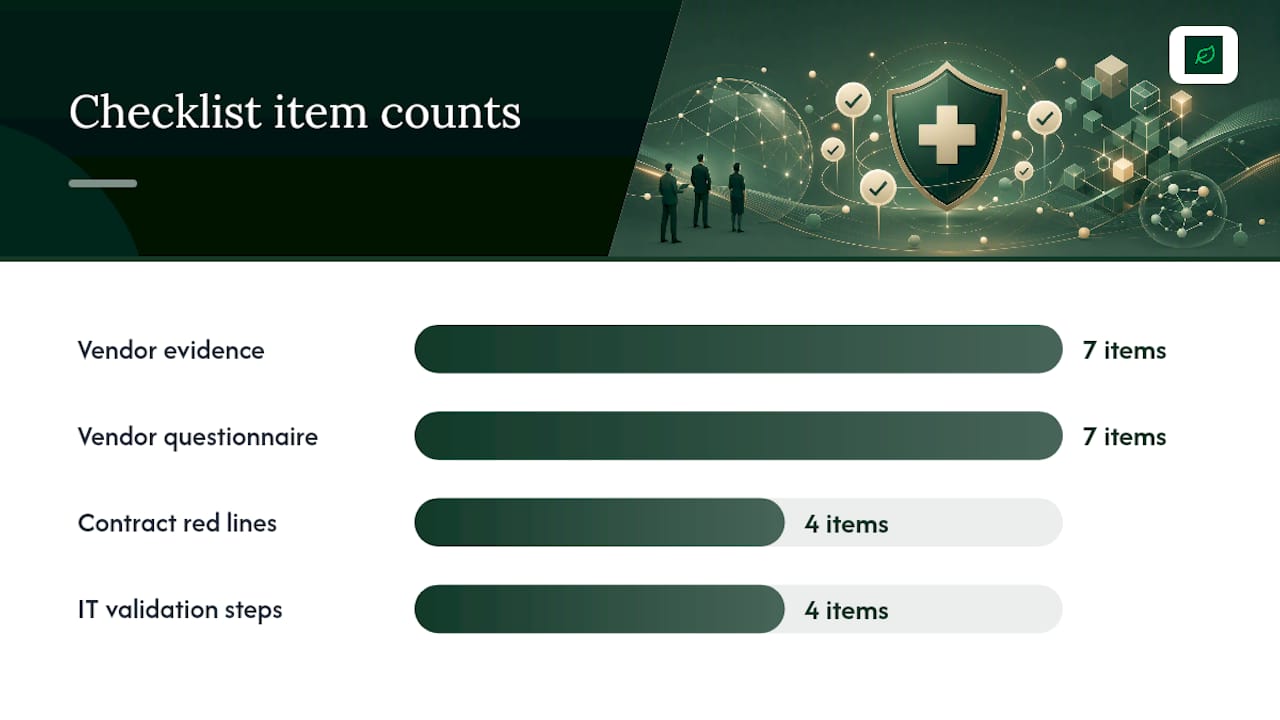
Vendor evidence to request before signing:
- SOC 2 Type II report (not Type I) covering the trust service criteria relevant to PHI protection
- Penetration test report from the past 12 months, conducted by an independent third party
- Written encryption architecture documentation (in transit and at rest)
- Access control policy and evidence of technical enforcement (not just a policy document)
- Data residency confirmation: where is PHI stored and processed?
- Complete subcontractor list with confirmation that BAAs are in place
- Incident response plan and evidence of tabletop exercises or drills
Sample vendor questionnaire items:
- Describe your encryption standards for PHI at rest and in transit.
- How do you enforce role-based access controls for PHI-handling systems?
- What is your mean time to detect and contain a security incident?
- Who is your designated HIPAA Security Officer?
- How frequently do you conduct workforce training on HIPAA requirements?
- Provide your most recent penetration test executive summary.
- List all subcontractors that may access PHI and confirm BAAs are in place.
Contract negotiation red lines:
- Reject any BAA that limits the BA’s breach notification obligation to “material” breaches only. Any breach of unsecured PHI triggers the obligation.
- Push back on liability caps set at the contract value when your PHI volume or patient population creates exposure far exceeding that amount.
- Require cyber liability insurance minimums in writing and make them a condition of contract renewal.
- Insist on audit rights that allow you to request security documentation annually, not just “upon reasonable notice” with no defined response timeline.
IT validation steps before go-live:
- Confirm TLS version and certificate validity on all API endpoints.
- Verify that PHI is not logged in application error logs or analytics events.
- Test that access controls prevent unauthorized lateral movement within the vendor’s system.
- Confirm that data deletion requests result in actual deletion, not just logical removal.
Common BAA Mistakes and Vendor Red Flags
The most expensive HIPAA mistakes are not the ones organizations know about. They are the ones hiding in plain sight: the analytics script on the patient portal, the scheduling widget that sends appointment data to a third-party server, the vendor that signed a BAA three years ago and has never been audited since.
Typical compliance mistakes:
- Assuming a signed BAA equals ongoing compliance. A BAA is a contract, not a control. The vendor’s actual security posture can deteriorate after signing.
- Failing to audit third-party scripts embedded in patient-facing websites. HHS is explicit that tracking vendors receiving PHI from appointment pages are business associates, and a cookie banner does not satisfy the BAA requirement.
- Missing downstream BAAs when a primary vendor adds subcontractors mid-contract.
- Conducting workforce training once at onboarding and never again. Role-based, ongoing training is a Security Rule requirement, not a one-time event.
- Treating “HIPAA-compliant” as a vendor certification. There is no federal HIPAA certification program. That phrase is marketing language.
Vendor red flags that warrant immediate escalation:
- Refusal to sign a BAA or insistence that their standard terms are “sufficient”
- Inability to produce a SOC 2 Type II report or equivalent security documentation
- No designated HIPAA Security Officer or incident response capability
- Vague answers to specific technical questions about encryption or access controls
- No workforce training program for staff who handle PHI
Remediation playbook:
Immediate (within 48 hours): Halt PHI transfers to any vendor that refuses a BAA. Document the decision and the date.
Short-term (within 30 days): Complete a full vendor inventory. Identify every vendor touching PHI and confirm BAA status. Escalate gaps to legal and procurement.
Long-term (within 90 days): Implement a vendor management program with annual BAA reviews, security documentation requests, and a renewal checklist that includes technical validation.
Pro Tip: Coordinate legal, IT, and procurement in a standing quarterly review. Legal owns the contract status. IT owns the technical control validation. Procurement owns the renewal calendar. When those three functions work in silos, gaps persist for years.
Contract Termination, PHI Disposition, and Audit Rights
The end of a vendor relationship is as legally significant as the beginning. Your BAA must specify what happens to PHI when the contract ends and give you the tools to verify compliance.
Contractual obligations at termination:
- The business associate must return or destroy all PHI in its possession upon termination.
- If return or destruction is not feasible (for example, PHI is embedded in backup systems that cannot be selectively purged), the BA must extend BAA protections to that retained PHI and limit further use or disclosure to the purpose that makes return or destruction infeasible.
- The BA must provide written certification of PHI destruction or return within a defined window after termination.
Audit rights: what to require operationally:
- Annual right to request SOC 2 Type II reports, penetration test summaries, and training completion records.
- Right to conduct or commission a third-party audit with reasonable notice (define “reasonable” as 30 days in the contract).
- Right to review access logs for PHI-handling systems upon request.
- Obligation for the BA to notify you of any material change to its security posture within 30 days.
Recordkeeping retention:
HIPAA requires covered entities to retain documentation of policies, procedures, and actions for six years from the date of creation or the date it was last in effect, whichever is later. Apply that same standard to BAAs, vendor security documentation, breach notification records, and audit reports. Store them in a system that preserves version history and timestamps.
Enforcing termination for material breach:
- Send written notice of the breach with a defined cure period (typically 30 days).
- If the BA fails to cure, terminate the agreement and immediately halt PHI transfers.
- Initiate PHI return or destruction procedures and document every step.
- Assess whether the breach constitutes a reportable incident under 45 CFR 164.410 and your own OCR reporting obligations.
Sample BAA Clauses and Where to Find HHS-Approved Language
The fastest way to draft a defensible BAA is to start with HHS’s sample BAA provisions, then customize for your vendor’s specific role, data types, and technical environment. The HHS sample language is not mandatory boilerplate, but it reflects the required elements of 45 CFR 164.504(e) and gives you a credible starting point.
Customization guidance for specific vendor types:
- Cloud and hosting vendors: Add data residency restrictions, specify encryption standards by name, and require notification if data is replicated to new geographic regions.
- Analytics vendors: Explicitly prohibit use of PHI for advertising, model training, or cross-site tracking. Require that PHI be excluded from any data aggregation or benchmarking products.
- Subcontractor-heavy vendors: Require an annual subcontractor attestation and the right to review subcontractor BAAs on request.
Pro Tip: Never accept a vendor-supplied BAA without running it through both legal review and a technical validation pass. Pay particular attention to the permitted-uses clause and the breach-reporting timeline. Those two provisions are where vendor-drafted BAAs most often diverge from your interests.
A Practitioner’s Take on Negotiating BAAs with Tech Vendors
The hardest BAA negotiations are not with traditional healthcare vendors. They are with SaaS companies, analytics platforms, and cloud-native tools that were not built with HIPAA in mind and whose legal teams have never seen a 45 CFR citation.
The pattern is predictable: the vendor’s sales team assures you they are “HIPAA-compliant,” their legal team sends a BAA that caps liability at one month’s subscription fees, and their security team cannot produce a SOC 2 report because they have not completed one yet. You are left choosing between delaying a product launch and accepting a BAA that does not actually protect you.
The right answer is to slow down. A BAA with inadequate liability terms and no audit rights is not meaningfully better than no BAA at all — it just creates the illusion of protection. Push for the SOC 2, push for a realistic liability cap, and if the vendor cannot meet basic security documentation requirements, that is your answer about their actual compliance posture.
For automation and AI integration projects specifically, the risk is compounded. An AI agent that processes patient intake data, schedules appointments, or routes clinical messages is touching PHI at every step. The underlying model provider, the orchestration layer, and the data storage system are all potential business associates. Treat each one as a separate BAA relationship, not a single bundled agreement with the primary vendor.
Pilots and sandbox environments deserve the same scrutiny. Use synthetic or de-identified data during development. If de-identification is not feasible, treat the pilot environment as a production BAA relationship from day one. The cost of retrofitting compliance after a pilot goes live is always higher than building it in at the start.
Sources
Every compliance officer working on BAAs should have these primary sources accessible, not just cited in a policy document.
- Hhs
- HIPAA Business Associate Agreement - 2026 Update
- 45 CFR § 164.504 - Permitted uses and disclosures; organizational requirements
The HHS sources are primary authority. The HIPAA Journal resource is useful for operational context and practitioner-level interpretation, but always verify against the CFR text and HHS guidance when drafting contract language.
FAQ
Is a BAA required for HIPAA compliance?
Yes. A BAA is required whenever a vendor creates, receives, maintains, or transmits PHI on behalf of a covered entity. Operating without one is a direct HIPAA violation, regardless of the vendor’s own privacy practices.
What are the key HIPAA BAA requirements under 45 CFR 164.504(e)?
A BAA must specify permitted uses and disclosures, require appropriate safeguards, obligate breach reporting, extend obligations to subcontractors, and require return or destruction of PHI at termination.
Do you need a BAA for a HIPAA-compliant website?
Yes, if your website collects or processes PHI through forms, scheduling tools, chat widgets, or analytics. Hosting providers, form processors, and tracking vendors that receive PHI are business associates and require BAAs. A cookie banner does not satisfy this requirement.
What happens if a business associate refuses to sign a BAA?
You must stop transferring PHI to that vendor immediately. Continuing to send PHI to a vendor without a BAA is a HIPAA violation. Vendor refusal is also a significant red flag about their compliance posture.
Are business associates directly liable under HIPAA?
Yes. The HITECH Act made business associates directly liable for specific HIPAA violations, including Security Rule failures and breach notification obligations. OCR can investigate and penalize a business associate independently of the covered entity.
This article provides general information about HIPAA BAA requirements and is not a substitute for legal advice. Consult qualified legal counsel and review current HHS/OCR guidance to confirm requirements applicable to your specific situation.
Building compliant systems for regulated industries is exactly what Cannatract does. If your organization needs a HIPAA-compliant website, a compliant automation workflow, or a vendor-integration architecture that accounts for BAA obligations from day one, Cannatract can scope and build it with a fixed quote and a 2–4 week delivery window. Book a free automation audit to start.